





Every few months, a new headline suggests that housing affordability might finally be “coming back.” Rates might fall. Prices might soften. Wages might rise.
But when you put all three on the same page, the math tells a much harsher story.
Today’s average mortgage rate sits at roughly 6.15%. To reach the level many buyers still mentally anchor to—around 2.65%—rates wouldn’t just need to dip. They’d need to collapse by several full percentage points. That kind of drop doesn’t come from normal economic cycles. It comes from emergencies.
At the same time, the median household income would need to rise to $132,171 to support homeownership under those ultra-low rate assumptions. In reality, median income today is closer to $84,763. That’s not a small gap. That’s nearly a $50,000 difference, and it assumes wage growth that vastly outpaces productivity gains, inflation, and historical trends.
Then there’s the home price side of the equation. For affordability to rebalance without changing how much income households devote to housing, the median home price would need to fall from roughly $418,000 to about $273,000. That’s a decline of more than a third, nationwide.
Think about what that would mean.
Millions of homeowners instantly underwater. Local governments watching property tax revenues shrink. Builders pulling back further. Lenders tightening even more. That kind of price correction doesn’t quietly improve affordability—it detonates balance sheets.
This is where the conversation usually stops being honest.
People talk about rates, or wages, or prices as if adjusting one lever will fix the whole system. It won’t. Housing affordability is a three-legged stool, and all three legs are currently the wrong length.
What makes this moment different from past cycles is that none of these variables are likely to move far enough, fast enough, or in the same direction to restore traditional affordability. Rates may ease, but not collapse. Wages may rise, but not by 50% in real terms. Prices may flatten or dip regionally, but not fall by $145,000 across the board.

Which leads to an uncomfortable conclusion: the old affordability model is gone.
Where Modular Construction Actually Helps (and Where It Doesn’t)
This is where modular construction often gets unfairly cast as either a miracle cure or dismissed entirely.
It’s neither.
Modular construction doesn’t change mortgage rates. It doesn’t raise wages. And it won’t magically drop land costs or eliminate regulatory friction. Expecting it to do those things is how disappointment gets manufactured.
What modular can do is attack the part of the equation that builders and developers actually control: the cost and predictability of producing a home.
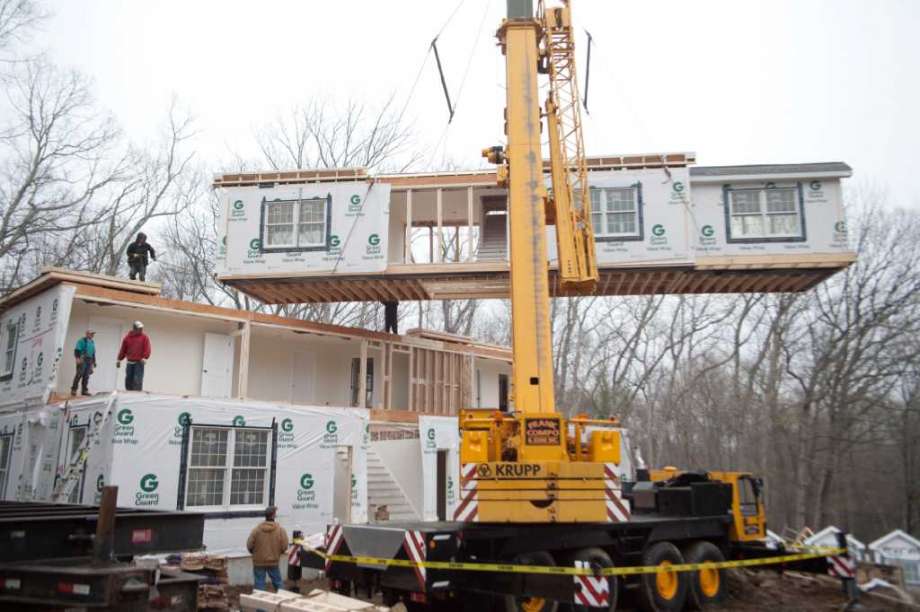
By shifting labor into controlled factory environments, modular construction reduces variability—the hidden cost driver that quietly inflates budgets on site-built projects. Weather delays, labor shortages, rework, sequencing failures, and trade stacking all add cost. Modular doesn’t eliminate those risks, but it compresses and stabilizes them.
Time matters here more than most people realize. Shorter build cycles reduce carrying costs, interest exposure, insurance, and site overhead. In a 6%+ rate environment, shaving months off a schedule isn’t a convenience—it’s real money.
Modular also forces discipline. Repetition, standardized details, and pre-engineered assemblies limit the kind of design creep that pushes homes out of reach one decision at a time. Smaller footprints, simpler forms, and fewer customizations aren’t glamorous, but they’re exactly what affordability math demands.
Where modular truly shines is at scale. Not one-off custom homes. Not boutique pilot projects. But repeatable product built hundreds or thousands of times, where learning curves flatten and efficiencies compound. That’s when cost reductions stick instead of evaporating.
The honest truth is that modular construction doesn’t restore the old affordability model. It supports a new one—where expectations shift, homes are designed for how people actually live, and delivery systems are aligned with economic reality.
Arithmetic, Not Optimism
Waiting for rates to crash, wages to surge, and prices to fall at the same time is not a strategy. It’s a hope dressed up as analysis.
Modular construction won’t solve affordability on its own, but it’s one of the few tools capable of bending the cost curve without destabilizing the entire housing market.
The numbers don’t point to a temporary imbalance. They point to a structural reset.
And in a reset, the winners won’t be the ones waiting for yesterday’s math to return.
They’ll be the ones who adapt their products, processes, and expectations to the arithmetic in front of them—whether they like it or not.
.
With more than 10,000 published articles on modular and offsite construction, Gary Fleisher remains one of the most trusted voices in the industry.
.
CLICK HERE to read the latest edition

Contact Gary Fleisher