



If you stand on the edge of my city today and look out over the horizon, you’ll see acres of concrete, steel, and truck bays stretching as far as the eye can see. In just five short years, more than 7 million square feet of logistics warehousing has risen from former fields and forgotten industrial land. A massive two-story Walmart distribution center anchors one end of the development. Six Amazon warehouses hum day and night, feeding the appetite of online commerce.
And a 15-story, one million sq ft, fully robotic-operated frozen food warehouse is being completed next to one of those Amazon warehouses. Unbelievable!
From an economic development standpoint, the story sounds like a win. Jobs came—thousands of them. Tax base expanded. The city made the kind of headlines mayors dream about.
But there’s a second story unfolding just a few miles away, and it doesn’t get nearly as much attention.
People need a place to live.
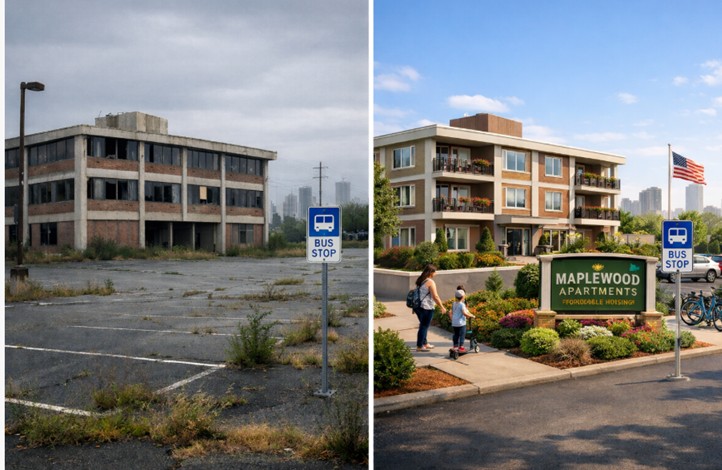
Rents are climbing. Entry-level housing is scarce. Long commutes are becoming the norm for workers who can least afford the time or the gas. And scattered throughout the city sit dozens of office buildings—quiet, underused, or completely empty—built within the last 30 years, structurally sound, but functionally obsolete in a post-pandemic world.
That contrast—booming warehouses on one side of town and empty offices on the other—presents a rare opportunity. Not a theoretical one. A very practical one.
The Office Buildings We No Longer Need

These aren’t century-old brick relics with failing floors and narrow windows. Most of these office buildings were designed in the 1990s and early 2000s. Steel or concrete frames. Generous floor-to-floor heights. Large footprints. Parking already in place. Utilities nearby.
What they don’t have is tenants.
Companies downsized. Remote work stuck. Lease renewals never happened. Owners are stuck holding assets that no longer perform as intended, while cities stare at a housing shortage they can’t permit their way out of fast enough.
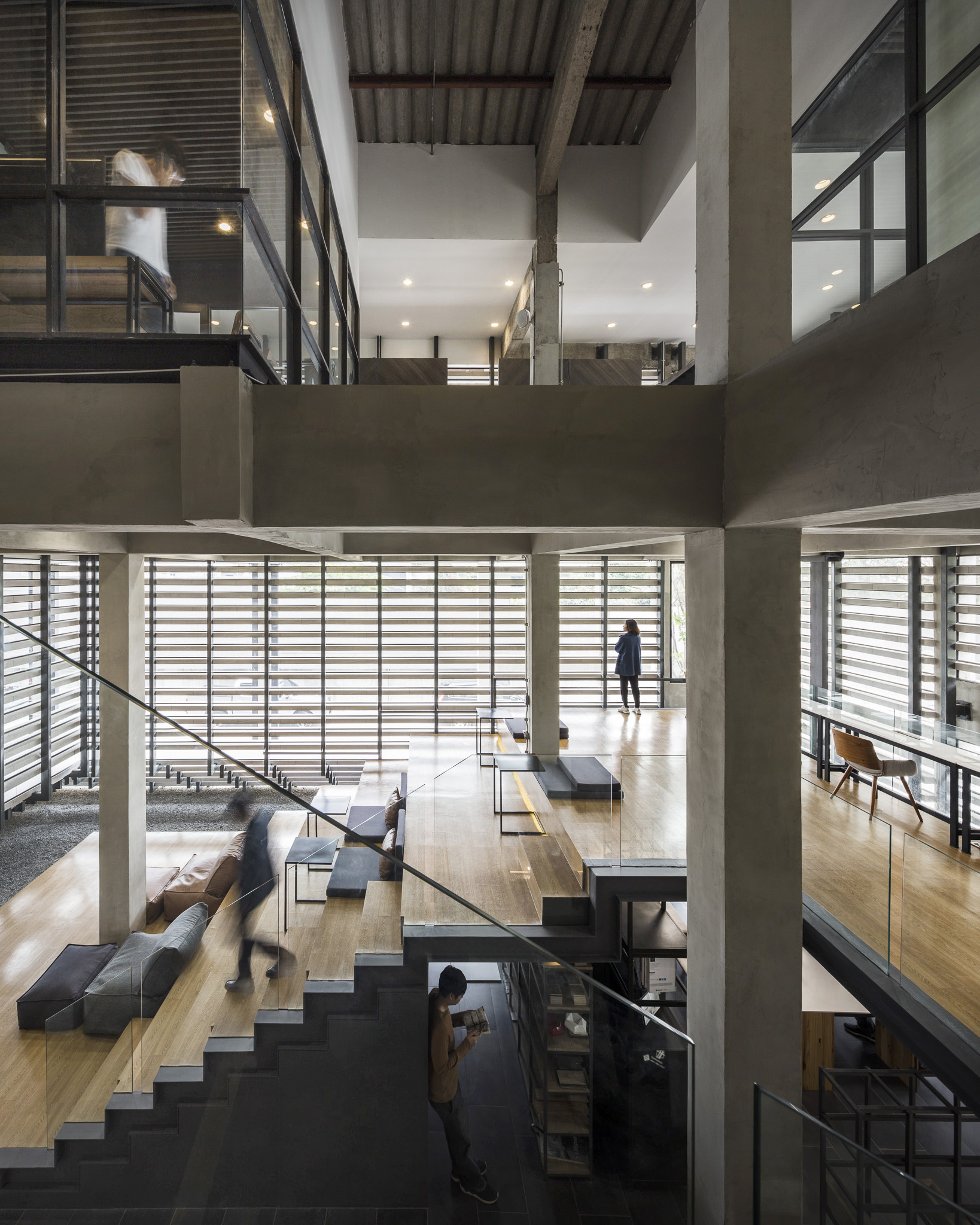
Traditional apartment conversions are possible—but expensive, slow, and risky. Custom layouts, extensive interior demolition, long construction schedules, and unpredictable costs can kill projects before they ever leave the spreadsheet.
This is where offsite construction—specifically modular factories and component manufacturers—could change the equation.
Slide-In Housing: A Different Way to Think About Conversions
Instead of treating each empty office building as a one-off renovation project, imagine treating them as shells—strong, dry, permitted structures waiting to be filled.
Now imagine a factory producing standardized, apartment-ready modules designed specifically to slide into those shells.
Not traditional volumetric modules stacked into a new building, but precision-built living units engineered to fit within existing floor plates. Think of them as “living cartridges”—complete with kitchens, bathrooms, mechanical systems, and finishes—manufactured under factory conditions and delivered just-in-time.
These modules could be:
• Narrow enough to fit through existing façades once glazing is removed
• Sized to align with column grids common in office construction
• Designed to connect vertically to centralized plumbing and mechanical risers
• Pre-finished to minimize on-site labor
Instead of months of interior framing, inspections, and rework, installation becomes a repeatable process. Slide in. Lock into place. Connect services. Move on to the next unit.
For modular factories, this is not a moonshot. It’s a natural extension of what they already do best: repeatability, quality control, and speed.
Where Component Manufacturers Fit In
Not every solution needs to be a fully volumetric module.
Component manufacturers—panelizers, floor cassette producers, bathroom pod specialists—could play an equally important role. Office buildings often need selective demolition, new exterior wall systems, upgraded insulation, and reconfigured corridors.
Imagine a conversion system built from:
• High-performance exterior wall panels replacing outdated curtain walls
• Prefabricated corridor assemblies with integrated fire and acoustic ratings
• Factory-built bathroom pods craned into place
• Mechanical chases and floor cassettes designed to drop into existing bays
By breaking the conversion into repeatable, factory-built components, costs become more predictable. Schedules tighten. Financing becomes easier. Risk drops.
For cities, this matters. For developers, it’s the difference between “interesting idea” and “financeable project.”
Why This Could Actually Stay Affordable
Affordable housing isn’t just about smaller units or cheaper finishes. It’s about controlling variables.
Every day shaved off a construction schedule saves money. Every avoided change order protects margins. Every factory-built unit reduces exposure to labor shortages and weather delays.
Slide-in modular and component-based conversions offer:
• Shorter construction timelines
• Reduced on-site labor requirements
• Better cost certainty for lenders
• Faster occupancy and revenue generation
And because the buildings already exist, land costs—the silent killer of affordability—are largely removed from the equation.
The warehouse boom created jobs quickly because logistics companies know how to replicate buildings efficiently. Housing has lagged because we’ve insisted on treating every project as bespoke.
Factories don’t think that way. And that’s exactly why they should be part of this conversation.
A Missed Opportunity—or a New Market
The irony is hard to miss. We can build millions of square feet of warehouses in record time, but struggle to house the people who work in them.
Empty offices aren’t a failure of planning. They’re a second chance.
For modular factories looking to diversify beyond single-family housing…
For component manufacturers searching for steady, urban-based demand…
For cities desperate for solutions that don’t take a decade…
This is a market hiding in plain sight.
The buildings are already there. The jobs are already there. The need is undeniable.
What’s missing is the willingness to rethink how housing gets delivered—and who delivers it.
And this time, the answer might not come from a job site. It might come from a factory floor.
.
With more than 10,000 published articles on modular and offsite construction, Gary Fleisher remains one of the most trusted voices in the industry.
.
CLICK HERE to read the latest edition

Contact Gary Fleisher