





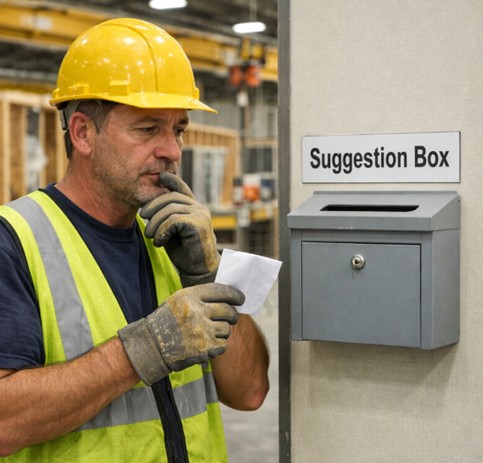
If there were a scoreboard hanging in most factories, it would read something like this:
Yes: 3
No: 247
Management, regardless of industry, has perfected the art of saying “No.” It rolls off the tongue effortlessly. No meetings required. No follow-up. No uncomfortable eye contact with the person who just suggested something that might—God forbid—change the way things are done.
“No” is efficient.
“No” keeps the day on schedule.
“No” doesn’t upset the organizational apple cart.
And in fairness, owners, GMs, and upper management aren’t evil people. They’re busy. They’re juggling production schedules, cash flow, inspectors, builders, suppliers, and the occasional banker who suddenly wants to “just check in.” The last thing they want is a surprise idea from the production line that might actually make sense—and require action.
So instead, “No” becomes the default setting.
Listening Is Harder Than Hiring a Consultant
Here’s one of the great ironies of factory life:
Management will happily bring in consultants, spend weeks in conference rooms, pay tens—sometimes hundreds—of thousands of dollars, and walk away with a thick report that confirms what everyone already knew.
But listening to the person who installs the same wall section 40 times a day?
That’s risky.
Because that person might be right.
And if they’re right, it raises uncomfortable questions. Why wasn’t this seen sooner? Why didn’t management notice? Why has this problem been tolerated for years?
Consultants don’t trigger those questions. Employees do.
Consultants leave. Employees stay.
The Mythical Manager of Suggestions
Every so often, someone jokes about needing a “Manager of Suggestions.” It usually gets a laugh, followed by the sound of that idea being quietly escorted out of the room.
Too bad—because most factories desperately need one.
Not a suggestion box.
Not an anonymous email address.
An actual human being whose job is to listen, translate, and follow through.
Because right now, suggestion systems tend to fall into two categories.
The first is the suggestion box that no one checks.
The second is the suggestion box that gets checked once, immediately after it fills up with notes suggesting who should be fired, where management can shove things, and a few creative anatomical references best left unpublished.
That’s not employee engagement. That’s bottled frustration.
Why Most Suggestions Are Angry (and Why That’s Management’s Fault)
When people feel ignored long enough, they stop offering solutions and start offering sarcasm.
Most employees don’t begin their careers wanting to complain. They begin by noticing inefficiencies. Extra steps. Repeated mistakes. Tools that don’t quite work. Processes that exist only because “that’s how we’ve always done it.”
They mention it once. Maybe twice.

Then they’re told:
“That’s not how we do things.”
“We tried that once.”
“Good idea, but not now.”
After that, the tone changes.
By the time a suggestion makes it into a box anonymously, it’s already passed through the “I tried to help” phase and landed squarely in the “Nobody listens anyway” phase.
Making It Easier for Management to Say Something Other Than “No”
Here’s the truth: most managers aren’t opposed to ideas. They’re opposed to chaos.
So if you want management to stop saying “No” so fast, you have to make listening feel safe, contained, and useful.
One simple shift changes everything:
Stop asking for opinions. Start asking for problem ownership.
A real suggestion answers three things:
What problem do you see?
How does it affect safety, cost, quality, or time?
What’s your proposed fix?
That turns a complaint into a conversation.
The Magic of Time-Boxed Listening
One of the biggest fears managers have—though few will admit it—is that listening will take forever.
So don’t let it.
Fifteen minutes. Once a week. One department at a time.
No debates. No defensiveness. No explanations of why the past made sense at the time.
Just listening.
When managers know there’s a clock running, they relax. When employees know they won’t be cut off mid-sentence, they focus.
Strangely enough, most good ideas don’t need more than a few minutes to explain.
Kill the Suggestion Box. Put on Boots Instead.
Suggestion boxes are passive. Listening isn’t.
A far better system is rotating managers onto the production floor—not to manage, not to inspect, not to correct—but to listen.
No promises. No immediate fixes. Just questions and note-taking.
It’s amazing how the dynamic shifts when someone in authority stops talking and starts writing.
And yes, this requires managers to put down their phones and look people in the eye. Consider it a growth opportunity.
Close the Loop—or Don’t Bother Asking
Nothing destroys trust faster than silence.
Every suggestion deserves a response. Even if the answer is “Not now.” Even if the answer is “We can’t do that.”
Respect isn’t agreement. Respect is acknowledgement.
When employees see that ideas don’t vanish into a black hole, they keep thinking. When they don’t, they stop trying.
And once that happens, no consultant in the world can bring those ideas back.
Start Small, Win Quietly
Here’s another management myth: every idea requires a budget.
Most don’t.
Many of the best improvements come from small pilots. One line. One shift. One week.
If it works, scale it.
If it doesn’t, say so—and thank the person who tried.
That last part matters more than you think.
Why Offsite Construction Could Lead the Way
Offsite factories are already systems-driven. They already track processes, repeat tasks, and measure output. They are perfectly positioned to professionalize listening.
A real “Suggestion Manager” wouldn’t be a feel-good role. It would be a profit role. Someone who collects ideas, evaluates them, tracks outcomes, and reports results in terms management understands.
Less waste. Fewer delays. Better morale.
Those are not soft benefits. They show up on the bottom line.
The Final Irony
Factories spend enormous sums trying to “innovate.”
Meanwhile, the answers are standing ten feet from the production line, holding a nail gun, wondering why nobody ever asks.
Management keeps saying “No” because it’s easy.
Listening is harder.
But it’s also cheaper than consultants—and far more effective.
Maybe it’s time we stopped asking why people don’t speak up anymore and started asking why we stopped listening when they did.
.
With more than 10,000 published articles on modular and offsite construction, Gary Fleisher remains one of the most trusted voices in the industry.
.
CLICK HERE to read the latest edition

Contact Gary Fleisher