


Why Modular Still Wins—Even When You Can’t Have All Three
There’s an old saying most of us have heard in one form or another: “You can have it faster, cheaper, or better—but you only get to pick two.”
It applies to cheeseburgers, new cars, shoes, and yes—modular housing.
Years ago, modular construction could honestly claim all three. Homes were built faster, they often cost less, and the quality regularly surprised people who had never set foot in a factory. Those days, at least on the cheaper front, have changed.
Higher material costs, tighter building codes, new energy requirements, labor shortages, and more regulations than most of us care to count have brought modular pricing much closer to site-built homes. That’s not a failure—it’s reality.
So today, the choice usually comes down to Faster and Better.
And honestly? Those two still matter a lot.
Faster Still Means Faster—Just Not the Way People Think
When people hear “faster,” they often imagine a house showing up overnight like a package from Amazon. That’s not how it works—but modular is still significantly faster where it counts.
I learned that lesson firsthand years ago when I was a sales representative for a major East Coast modular manufacturer. I made it a point to be on-site the day a home was being set whenever I could. There’s nothing quite like watching months of planning turn into a house in a matter of hours.
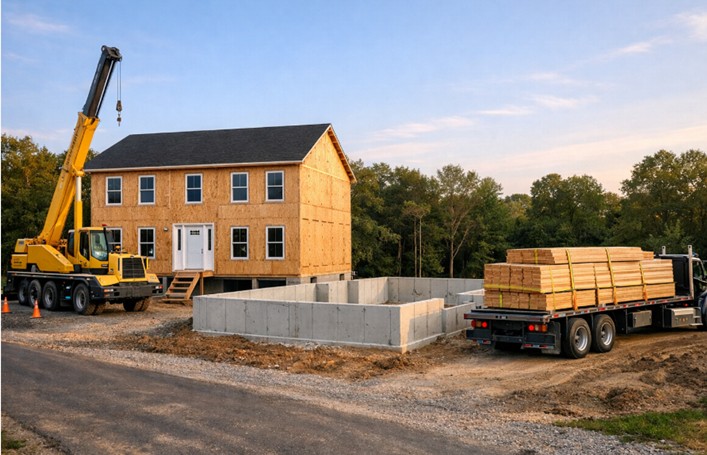
On one job in particular, I pulled into the site and immediately noticed two Superior Wall foundations sitting side by side. One was ours. The other belonged to a site-built home that hadn’t yet begun.
Our modules were delivered, craned into place, and secured in a couple of hours. The set crew was packing up, the crane was getting ready to leave, and just as they were about to pull out, a flatbed truck rolled in and unloaded the first stack of framing lumber for the neighboring foundation.
I stood there for a moment and took it all in. I even snapped a Polaroid of the scene—two foundations, two very different timelines. Unfortunately, that photo disappeared during one of my many moves over the years, but I never lost the memory.
It said everything that needed to be said about modular being faster.
And that kind of speed still matters today—especially in parts of the country where winter weather can shut down site-built construction for weeks or even months. While foundations and septic systems wait for the frost to leave the ground, modular factories keep building indoors, preparing homes so they’re ready the moment the site is.
Then comes the second kind of “faster” that rarely gets enough credit: time to completion after set. Once modules are in place, the finish work moves quickly. Mechanical connections, interior details, and final inspections happen in weeks, not months, getting homeowners moved in sooner and reducing carrying costs along the way.
And Then There’s “Better”
This is where modular quietly shines.
Between third-party inspections and in-house quality control, modular factories don’t guess whether the house matches the plans—they know it does. Every stage is checked, documented, and rechecked before anything ever leaves the factory floor.
Walls are square. Materials are protected from weather. Trades aren’t rushing to beat a storm or working around each other in the mud. The result is consistency—and consistency is a big part of what “better” really means.
It’s not flashy. It’s reliable. And homeowners notice it after they move in.
The Benefits We Don’t Talk About Enough
One of the most overlooked advantages of modular construction has nothing to do with speed or structure—it’s everything else.
Less waste.
Better energy performance.
Fewer deliveries to the jobsite.
Fewer workers driving back and forth every day.
These things matter—especially to Millennial and Gen Z buyers, who often expect sustainability and efficiency as a baseline, not a bonus. Many factory-built homes already meet those expectations, even if no one bothered to point it out during the sales conversation.
When someone buys a modular home, those benefits are usually baked in—whether the brochure mentions them or not.
So What’s the Takeaway?
No, modular isn’t always cheaper anymore.
Yes, it’s still faster—where it counts.
And absolutely, it’s often better—by design.
If you’re choosing between faster, cheaper, or better, modular may no longer promise all three. But the two it delivers today still make a strong case—especially for buyers who value quality, efficiency, and a smarter way to build.
And that’s not a bad trade at all.
.
With more than 10,000 published articles on modular and offsite construction, Gary Fleisher remains one of the most trusted voices in the industry.
.
CLICK HERE to read the latest edition

Contact Gary Fleisher