



When a modular home factory closes, the first reaction is usually to ask what went wrong.
Was there not enough demand? Did the company run out of cash? Was management inexperienced? Did production costs get out of control? Or was the factory simply built in the wrong place at the wrong time?
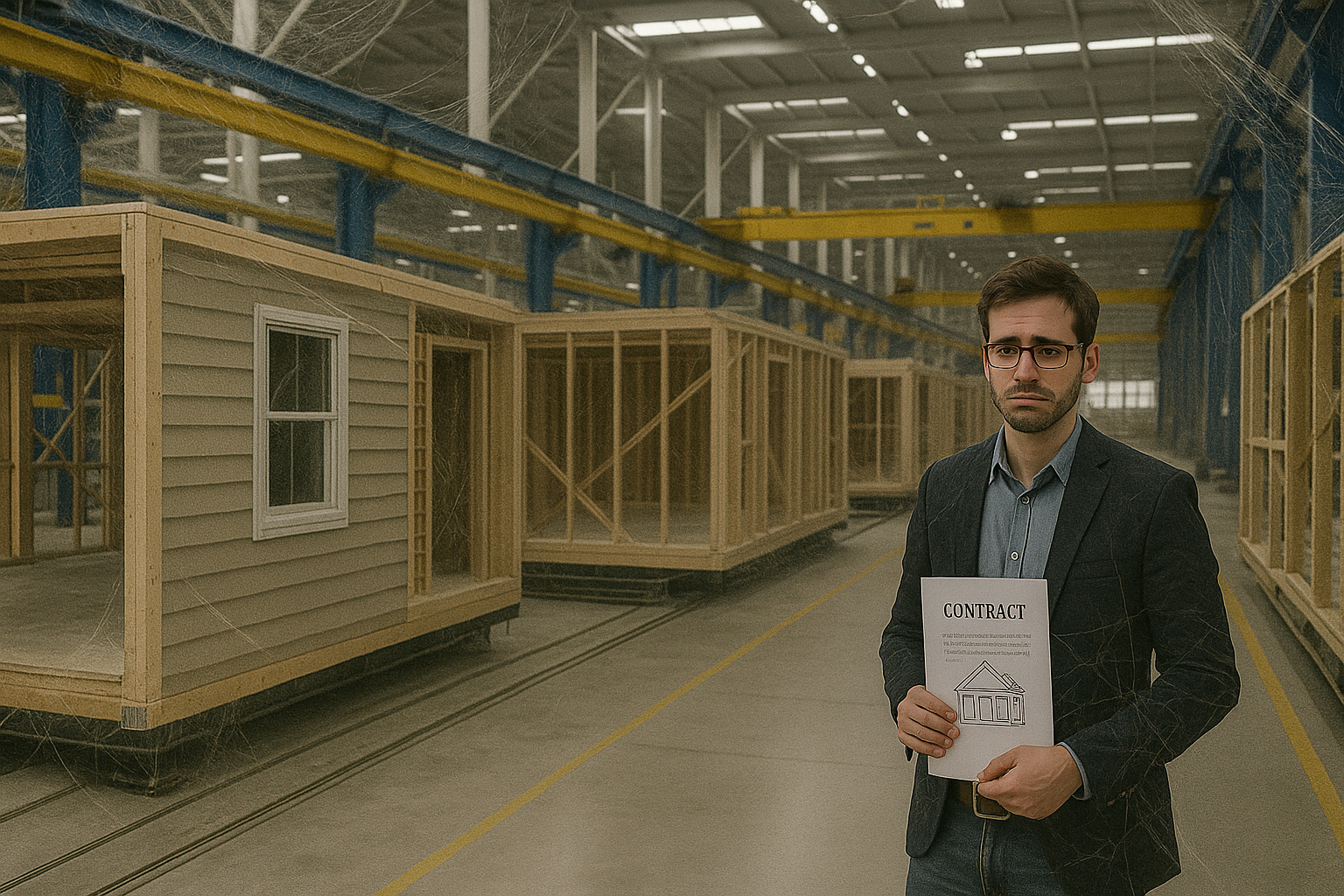
Those are important questions, but a factory closing does not necessarily mean the facility itself was the problem. Sometimes the building, equipment, workforce, and location still have considerable value. What failed may have been the business model operating inside them.
For the right buyer, a recently closed modular factory could offer an opportunity to enter production faster and for far less money than constructing a new facility. However, that opportunity exists only if the buyer understands exactly why the previous operation failed—and has a credible plan to prevent it from happening again.
The Value of a Running Start
Starting a modular factory from the ground up can take years. A company must locate a suitable property, obtain zoning and permits, design the production layout, install utilities, purchase equipment and secure the necessary state or third-party approvals.
A recently closed factory may already have much of that infrastructure in place. Production lines, framing tables, overhead cranes, compressed-air systems, material-storage areas and loading facilities may still be usable.
That does not mean the factory can immediately begin producing homes under new ownership. Equipment must be inspected, approvals may need renewal, and the production layout may not match the new owner’s building system. Still, inheriting a workable industrial foundation can eliminate months—or even years—of planning and construction.
A Good Location Usually Remains a Good Location
Modular factories are not ordinary warehouses. Their locations must support moving oversized modules, accessing major highways, delivering building materials, and recruiting workers familiar with construction or manufacturing.
If the closed factory was well positioned when it opened, many of those advantages may still exist. Nearby suppliers may already understand factory requirements, local officials may be familiar with modular production, and regional builders may know how to work with the facility.
However, buyers should not assume the original location was ever truly suitable. Some factories were placed in areas with limited markets, inadequate labor pools or transportation routes that restricted module size. A location can look attractive on a map and still create expensive operational problems.
Used Equipment Can Be a Bargain—or a Trap
Factory equipment often sells for far less than its original purchase price after a closure. Framing tables, saws, cranes, material-handling equipment and specialized tools may be available as part of the property or through a separate liquidation sale.
That can produce substantial savings, especially when compared with the cost and lead time of buying new machinery.
The danger is assuming that inexpensive equipment is automatically valuable. Some machinery may be obsolete, poorly maintained or designed for a production process the new owner does not intend to use. Highly specialized automation can be especially difficult to repurpose without the original software, technical support and employees who understood how to operate it.
The equipment price matters less than the cost of making it productive again.
The Former Workforce May Be the Greatest Asset
One of the strongest reasons to consider a recently closed factory is that experienced employees may still be available.
These workers may understand the production line, local suppliers, quality-control requirements, and the small daily details that never appear in an operations manual. Rehiring even part of the former team could reduce training time and help the new company avoid repeating old mistakes.
That opportunity does not last indefinitely. Experienced employees must find other jobs, and the best people are often hired elsewhere first. A buyer who waits too long may acquire the building and equipment but lose the institutional knowledge that once made the facility productive.
Must another question be asked: Did the employees leave because the factory closed, or did the factory struggle because too many good employees had already left?
The Most Important Question Is Why It Closed
Every prospective buyer will hear a simplified explanation for the closure. The company was undercapitalized. Interest rates rose. A major customer disappeared. The market slowed. Management made mistakes.
The real answer is usually more complicated.
A factory may have had plenty of orders but priced them incorrectly. It may have generated revenue while losing money on every module it produced. Production may have been efficient while engineering, permitting, transportation, or site completion created delays and unexpected costs. The company may have accepted projects that were never appropriate for its building system.
In other cases, the factory was constructed before the company had enough committed customers to support it. Management assumed that opening production capacity would create demand. Unfortunately, an empty order book does not become full simply because a factory is ready to build.
Before acquiring the operation, a buyer must separate problems caused by the former owner from problems built into the facility, location or market.
Existing Relationships May Still Have Value
A closed factory probably had relationships with suppliers, builders, developers, transporters, set crews and local officials. Some of those connections may be worth rebuilding, particularly if the previous company was respected before its financial problems became public.
The closure may also have created a gap in the regional market. Builders who relied on the factory could be searching for another supplier, and developers may still have projects that need production capacity.
However, relationships do not automatically transfer with the real estate. Former customers may have lost deposits, experienced long delays, or been left with unfinished projects. Suppliers may have unpaid invoices. Builders may be reluctant to return without proof that the new owner is financially and operationally different.
The buyer may acquire the factory overnight, but rebuilding confidence will take longer.
The Old Name May Not Be Worth Saving
If the former company had a strong reputation, a new owner might benefit from retaining part of its identity. Customers and builders may already recognize the name, and the factory may have completed hundreds of successful projects before encountering trouble.
But a recognizable name is not always a valuable brand. If the closure left customers, vendors and employees angry, purchasing the old identity could also mean inheriting its reputation.
A new owner must decide whether to revive the former brand, modify it or make a clean break. Sometimes the most reassuring message to the market is not that the old factory has reopened. It is that an entirely new company, with new leadership and sufficient capital, is now operating in the same facility.
The Purchase Price Is Only the Beginning
A closed factory may be available at a fraction of its original cost, but the acquisition price can be misleading. Restarting production requires working capital for payroll, materials, insurance, engineering, certifications, marketing and operating expenses long before completed homes generate dependable cash flow.
Equipment may need repairs. The roof, electrical service or fire-suppression system may require upgrades. Former approvals might not transfer. Environmental issues or liens could be waiting beneath what appears to be an attractive deal.
The building might be inexpensive because no one else has found a profitable use for it.
A serious buyer needs more than enough money to purchase the property. It needs enough capital to correct hidden problems, rebuild the organization and survive a slower-than-expected production ramp-up.
Due Diligence Must Go Beyond the Real Estate
Evaluating a closed modular factory requires several kinds of due diligence at the same time. The buyer must examine the building and equipment, but also the former company’s pricing, customers, workforce, production history, and market position.
Among the questions that should be answered are:
- Why did the company actually close?
- Was the factory ever consistently profitable?
- How much working capital will the restart require?
- What equipment is usable, and what must be replaced?
- Are former employees available and willing to return?
- Did customers and suppliers lose money in the closure?
- Is there enough verified demand within the factory’s delivery radius?
- Can the new owner secure the necessary approvals and inspections?
- Does the proposed product match the facility and regional market?
- What will the new management team do differently?
If those questions cannot be answered, the buyer is not acquiring an opportunity. It is acquiring an expensive collection of assumptions.
Gary’s Observation

A closed modular factory can be a hidden gem, but it can also be a monument to bad planning, inadequate capital, or demand that never existed.
The building, production line and equipment are only part of what makes a modular factory successful. The real business includes sales, estimating, engineering, purchasing, production management, transportation, site coordination and cash flow. If any of those pieces are missing, reopening the factory will not solve the underlying problem.
The right buyer may be able to purchase years of infrastructure development at a significant discount, rehire experienced workers and reestablish valuable customer relationships. That is a real advantage.
But the buyer must never confuse buying a factory cheaply with operating one profitably.
Sometimes the previous owner’s failure creates an extraordinary second chance. The opportunity belongs to the buyer who understands why the first chance was lost.