






In a bid to revolutionize the residential construction
industry, developer Forest City Ratner announced Wednesday it would build the
first phase of the $4.9 billion 15-building Atlantic Yards residential and
commercial project with modular construction technology.
More than 60 percent of the construction for the entire
project would be completed off-site, in Building 293 at the Brooklyn Naval
Yard, where the modules are assembled.
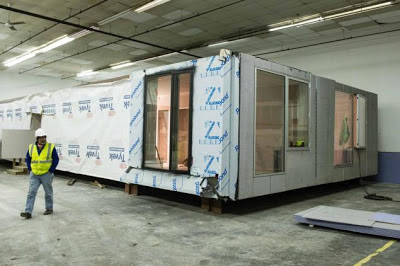
Modular construction allows builders to make
structures in controlled indoor environments similar to automobile assembly
lines. Modular construction is expected to decrease costs while delivering the same
reliability as traditional means — and
wants to be an international industry leader.
The modules are being fabricated at a super-secret plant
inside the Brooklyn Navy Yard. They will be trucked over to the Atlantic Yards
site and stacked.
Mr. Ratner began exploring modular construction during the
recession in 2010 as a way to make good on his promise to use union labor,
deliver good architecture and earmark at least 30 percent of the proposed 6,430
units for low- and moderate-income tenants. (Half of the 363 apartments in the
first building will be for poor and working-class families.)
He replaced the architect Frank Gehry with SHoP Architects
and worked with engineers from ARUP to devise a modular high-rise building.
also worked with a modular builder in
Jersey
had a bitter breakup over terms and Mr. Ratner’s decision to hire a group of
Kullman’s senior executives.
The developer obtained a financing commitment from Bank of
New York and forged a partnership with Skanska, the giant construction company
based in
and with union labor, the project’s biggest supporter during years of
opposition from some community groups.
company to operate the Navy Yard factory, with Skanska as the operating partner
as well as the construction manager. The companies declined to reveal the
start-up costs.
If it works, Mr. Ratner and his partners say, they will be
at the forefront of a new industry.
The 22-acre site will first house the world’s tallest
modular building, a 32-story residential structure named B2, located at the
corner of
and Flatbush Ave. Ratner will break ground on B2 on Dec. 18. The company said
it would finish the building by summer 2014.


After that, the
even taller pre-fab buildings.
The interiors of the modular units are similar to
traditionally built housing.
Designed by SHoP Architects, the same lower Manhattan-based
firm that completed
363 residential units with 50% earmarked for low- to middle-income residents.
All apartments will have oak wood floors and eco-quartz countertops.
Exteriors consist of setbacks giving the impression of three
structures stemming from one. Façade materials include perforated metal frames,
beveled channels, and metal panels projecting out. Rather than concrete, the
buildings will be held together by a structural steel system. There will be 23
different unit types with 64 variations.

Union workers made significantly less money building modular
units than they would at a traditional construction site.
“The goal here is that modular will be invisible to the
consumer,” says MaryAnne Gilmartin, FCR executive vice president in charge
of Atlantic Yards. “There is going to be a learning curve, but we believe
modular housing is beautiful and produces a better quality end product. We want
to demystify it.”
pre-fabricated housing after breaking with the project’s initial architect
Frank Gehry, whose design proved too costly to build.
SHoP principal Jonathan Mallie, who manages the firm’s
construction sister company, said there’d be no loss in style just because the
buildings are a jigsaw puzzle.
“The pre-conceived notion is that modularity does not
mean good design,” he said. “That’s false. In the long run this is more
sustainable and will reduce noise and disruption on the construction site. This
is the future of construction.”
for modular technology. Partnering with Skanksa, a global construction
conglomerate building the 7 train extension on
company that will execute Atlantic Yards and other local and national projects.
“The idea is to make the development more cost
effective,” said William Flemming, president and CEO of Skanska USA
Building. “How they pass along the savings to the end user is up to them.
This is not a new type of building. We’re working to perfect it with each new
project type.”
What is new is the relationship between construction unions
and modular, pre-fabricated building. In an agreement between
and the local trade labor unions, construction at the Navy Yard facility will
employ union workers earning $55,000 per year, or 25 percent below the average
construction wage.
to using union workers, but ran into financial troubles during the recession.
Company officials negotiated a new deal with the unions that backed the
project.
“The industry is evolving and we have to evolve with
it,” said Gary La Barbera, president of the Building and Construction
Trades Council of Greater New York. “This is an area that we are not
actively involved in. It opens up new markets for us and allows us to make
inroads with residential and affordable building, two areas we need to do
better.”
And the pay cut?
“It’s not a pay cut,” said La Barbera. “We’re
trying to create jobs for our members. I mean this as a 125-person modular jobs
and we have 100,000 members. Also, the first six months of this job are no
different than a regular job with site excavation and building the steel structure.
This whole thing is a win-win for everyone.”
One question future renters may ask is about how pre-built
boxes connected by metal will hold in a hurricane.
“There will be no difference than a regular built
structure,” said SHoP’s Mallie. “We comply with all
be better than other buildings. Being able to test the quality with such detail
in a controlled setting will make these buildings stronger.”