



Somewhere between the third robotics demo video and the fifth spreadsheet revision, a lot of offsite factory owners convince themselves they’ve found the answer. Not an improvement. Not a tool…But the answer.
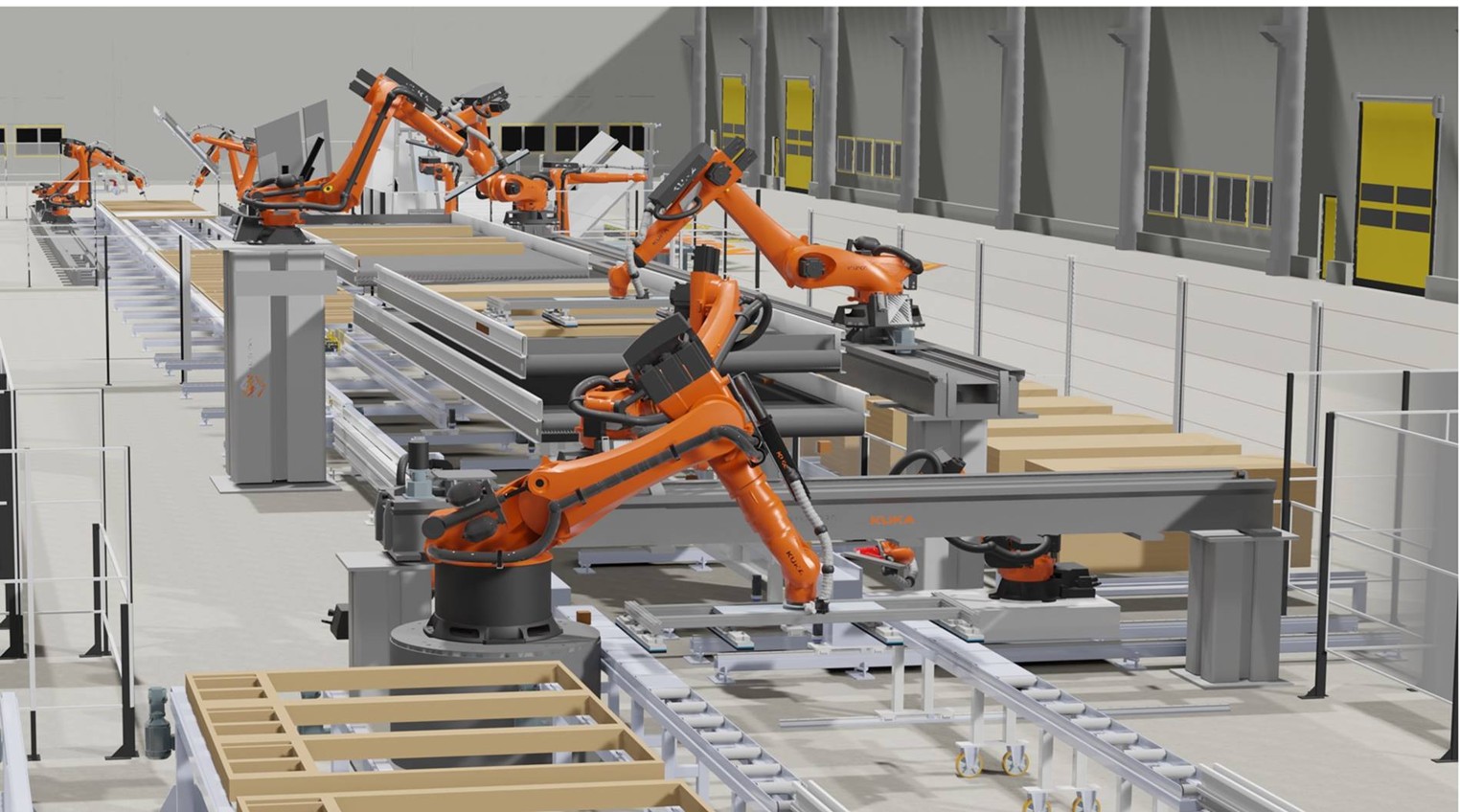
Six robotic arms. Two automated tables. No more labor headaches. No more hiring panic. No more production bottlenecks. Just machines doing what machines do best while humans supervise quietly from a distance.
It’s a seductive story.
It’s also dangerously incomplete.

Robots don’t fail because they don’t work. They fail because expectations are built on bad assumptions—and factories pay for those assumptions for a decade.
The First Question Factories Rarely Ask Honestly
Before talking about ROI, productivity, or Industry 4.0, there’s a question every factory should answer without flinching:
How many people do these robots realistically replace?
Not theoretically. Not in marketing material. Not in a perfect world with flawless uptime and zero changeovers.
In a real modular factory, running real product, with real variability.
Six industrial robotic arms paired with two automated tables should realistically replace between eight and fourteen direct labor positions on a single shift.
That range matters.
If the system replaces fewer than eight workers, the robots aren’t solving a labor problem—they’re compensating for process confusion. If the factory assumes they’ll replace fifteen or twenty people, it’s not planning; it’s gambling.
A disciplined, believable planning number is ten workers replaced. Not eliminated from the business, but removed from repetitive, high-strain, consistency-critical tasks and redeployed elsewhere.
Anything above that deserves skepticism. Anything below that deserves a pause.
The Labor Cost Everyone Underestimates
A $30-per-hour wage doesn’t sound catastrophic—until you stretch it over time.
At $30 an hour, forty hours a week, fifty-two weeks a year, one worker earns $62,400 annually. That’s before overtime. Before benefits. Before payroll tax. Before workers’ comp, turnover, or training.
Now apply a modest 2% annual wage increase over ten years.
Over a decade, that single worker costs roughly $683,000 in wages alone.
Multiply that by ten workers and labor costs quietly swell to $6.83 million. Eight workers cost about $5.46 million. Twelve push past $8.2 million.
This is the real comparison point automation must face—not hourly wages and not headcount fantasies.
The Robot Price Is the Most Misleading Number
This is where optimism sneaks in.
Factories focus on the sticker price of a robot arm. Fifty thousand here. Eighty thousand there. Six robots don’t look terrifying on paper.
But robots don’t work alone.


Once you add end-of-arm tooling, sensors, vision systems, safety guarding, scanners, controls, automated tables, integration, commissioning, training, and inevitable facility modifications, the real number shows up.
A realistic upfront investment for six robotic arms and two automated tables in a modular factory typically falls between $1.4 million and $5 million. Most factories land around $2.1 million when the dust settles.
That’s just to get the system operational.
The Cost That Never Leaves the Building
Robots don’t call in sick. They don’t complain. They don’t quit.
But they do demand constant care.
Maintenance, spare parts, wear components, programming tweaks, software updates, safety recertifications, retraining, and troubleshooting are not optional. They are permanent.
Over ten years, ongoing operating costs for a robotic system like this typically run between $350,000 and $900,000 per year, depending on complexity and duty cycle.
In the middle—where most factories actually live—that’s about $565,000 annually, or $5.65 million over a decade.
Add that to the upfront investment and the true ten-year cost of ownership settles in around $7.8 million.
That’s the number automation has to justify—not the demo-day estimate.
The Break-Even Line Nobody Likes to Admit Exists
Now the uncomfortable math.
If the robotic system replaces ten workers, labor savings over ten years are roughly $6.83 million. That doesn’t beat the system cost—it barely matches it.
If it replaces twelve workers, the numbers finally tilt positive.
If it replaces fewer than eight, the system never pays for itself in direct labor savings.
That means automation does not automatically improve cash flow. At best, it trades labor volatility for capital certainty. At worst, it locks a factory into a fixed cost structure it can’t unwind.

This is where many factories get trapped—owning impressive technology that only works when volume stays high.
Labor Flexes. Robots Don’t.
Here’s the part spreadsheets rarely show.
When volume drops, labor slows naturally. Overtime disappears. Hiring pauses. Headcount adjusts.
Robots don’t adjust.
Depreciation keeps running. Maintenance contracts stay in place. Automation staff still need paychecks. Software licenses don’t care about order volume.
Automation reduces chaos—but it also removes flexibility.
Factories that automate without acknowledging this are often shocked during the first real downturn.
Predictability Is the Real ROI—If You Can Afford It
Where robots truly earn their place isn’t labor elimination. It’s predictability.
They stabilize throughput.
They tighten tolerances.
They reduce rework.
They compress schedules.
They remove variability caused by fatigue, turnover, and skill gaps.
For factories struggling with inconsistency, injury risk, or quality escapes, that stability can be worth millions—even if labor savings barely break even.
But that value must be intentional. It cannot be an after-the-fact justification.
The Staffing Myth That Breaks Automation Projects
One of the most dangerous assumptions factories make is this:
“We’ll just hire one programmer.”
No.
A system of this scale requires, at minimum:
an automation or controls engineer,
a robot or mechatronics technician,
and outside integrator support when things go sideways.
Those people are not optional. They are part of the system.
Factories that underestimate this don’t just lose money—they lose credibility with their workforce when robots sit idle waiting for help.
The Factories That Get Robotics Right
Successful factories don’t automate to eliminate people. They automate to control risk.
They start with bottlenecks, not full lines.
They pilot before scaling.
They redeploy workers instead of discarding them.
They budget pessimistically and celebrate conservative wins.
Most importantly, they ensure the business survives even if automation underperforms.
The Modcoach Warning
If your factory needs robots to replace more than ten people just to justify the investment, stop.
That’s not strategy. That’s hope with a purchase order.
Automation should make a good operation better, not prop up a fragile one. Robots are not a rescue plan. They are a long-term commitment.
And when they don’t deliver miracles, the math doesn’t negotiate.
.
With more than 10,000 published articles on modular and offsite construction, Gary Fleisher, The Modcoach, remains one of the most trusted voices in the industry.
.

CLICK HERE to read the latest edition

Contact Gary Fleisher