
Every once in a while, something obvious sits right in front of us for years—sometimes decades—and we still manage to walk right past it.
Manufactured housing has done that to the modular industry.
Aside from the long-standing conversation about HUD Code versus IRC, which usually dominates any comparison between the two, manufactured housing has another advantage that rarely gets the attention it deserves. And it has nothing to do with quality, speed, or even cost.
It has everything to do with options.
The Power of “Pick One of These”
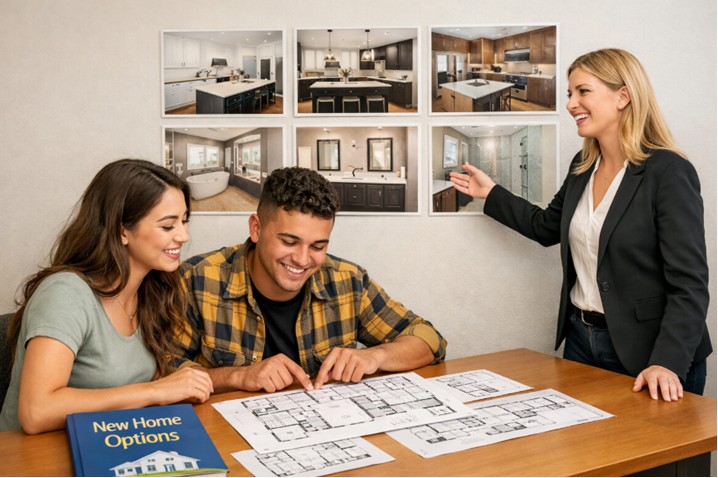
Walk into almost any manufactured home sales center and the process feels surprisingly calm and predictable. The buyer begins by choosing a floorplan from a well-established library—homes that have been built many times before, refined over years, and fully approved by the factory. Each of those homes comes with a clearly defined standard package, which keeps the base price straightforward and affordable.
Then comes the part buyers enjoy most.
If they want to keep costs down, they stick with the standard finishes and features. If they want to personalize their home, they choose from a factory-approved menu of options that has already been designed, priced, and vetted. Nothing is improvised. Nothing is promised casually. Everything has a reason for being there.
Choice is offered, but only within boundaries the factory can confidently deliver.
Manufactured Housing’s Quiet Secret
What manufactured housing figured out long ago is something modular still struggles to accept: giving buyers choices doesn’t have to create chaos.
Options are not unlimited. They are curated. Buyers can select from approved exterior colors, interior palettes, cabinet styles, countertop materials, appliance packages, bathroom configurations, and increasingly sophisticated upgrades such as walk-in closets, fireplace feature walls, and built-in shelving systems. These options are popular because they feel personal, not because they are endless.
Not every option works with every floorplan, and that limitation is made clear upfront. Certain kitchens only fit certain layouts. Some fireplace walls require specific structural conditions. Buyers understand that because the system is explained logically, not apologized for later.
The result is something rare in construction: a sense of customization without unpredictability.
Meanwhile, Over in Modular…
Now compare that experience to what happens in much of the modular world.
Yes, some modular factories specialize in large developer-driven projects where nearly every detail is custom. That makes sense. Those factories are built around project management, extended engineering cycles, and highly specific specifications.
Other modular companies are true custom home builders who simply use modular construction as the delivery method. That model also has its place.
But what’s largely missing in between is the manufactured housing-style factory model: standard homes with standard options.
Many modular factories live in a gray zone. They’re not fully standardized, yet they’re not truly custom either. Sales teams often promise flexibility in order to win work. Engineering then spends time untangling those promises. Production absorbs the variability. Purchasing reacts instead of plans. Schedules stretch. Margins quietly erode.
Everyone works harder than they should—and wonders why profitability feels elusive.
The Fear Behind the Resistance
When the idea of a structured option system comes up in modular circles, the pushback is almost automatic. Modular is “different.” Customers “expect more flexibility.” Markets “won’t accept limits.” Options will “slow down the line.” Every variation introduces risk.
Some of these concerns are legitimate. Many, however, are inherited assumptions that have gone unchallenged for years.
Manufactured housing once faced the same concerns. They solved them not by eliminating choice, but by designing choice into the system before it ever reached the sales desk.
This Isn’t a Technology Problem
Here’s where the conversation gets uncomfortable.
The modular industry now talks nonstop about automation. We talk about automated tables, robotics, AI-driven scheduling, digital twins, and predictive analytics. We’re told the factory of the future will be flexible, intelligent, and adaptive.
So it’s fair to ask: if we can automate wall framing, material handling, and production sequencing, why can’t we automate options?
Manufactured housing didn’t wait for artificial intelligence to solve this problem. They built option systems using binders, spreadsheets, and experience. Today’s modular factories have exponentially more powerful tools—and yet many still treat options as exceptions rather than systems.
That suggests the obstacle isn’t technology.
It’s mindset.
Options Are a System, Not a Sales Promise
In manufactured housing, options are treated as part of the production system. Engineering defines them. Production approves them. Purchasing locks them in. Pricing is consistent and transparent. Sales explains them clearly and confidently.
In modular construction, options are often treated as negotiations. A buyer asks. A salesperson agrees. Engineering questions it. Production tolerates it. Purchasing scrambles. Pricing gets revisited midstream. Apologies follow.
Those two approaches lead to very different results, even when the homes look similar on paper.
Why This Matters More Than Ever
Today’s buyers—especially younger buyers—are used to making choices within structured systems. They configure vehicles, kitchens, and even software packages with defined boundaries. They don’t expect unlimited freedom. They expect smart freedom.
Manufactured housing delivers that experience better than modular in many markets, not because it’s cheaper or simpler, but because it’s clearer.
Modular construction has spent years trying to explain why it’s better. Manufactured housing often doesn’t explain at all—it just works.
The Missed Opportunity
Imagine a modular factory offering a small but refined library of proven homes, each with transparent base pricing and a factory-approved option matrix that ties directly into production reality. Visual tools would reflect what can actually be built, not what might be possible. Schedules would remain predictable regardless of which options are selected.
That factory wouldn’t be giving up flexibility. It would be gaining control.
Sales would stop guessing. Engineering would stop redesigning the same solutions. Production would plan instead of react. Purchasing would forecast instead of chase. Profitability wouldn’t improve because homes got cheaper, but because inefficiency got removed.
The Question Modular Has to Answer
This isn’t about copying manufactured housing. It’s about learning from it.
Manufactured housing solved the option problem because it had no choice. Volume demanded discipline. Survival demanded systems.
Modular construction is now at a similar crossroads. It talks like an industrialized industry, but often behaves like a custom builder with better logistics.
If modular factories truly believe in automation, robotics, and AI, then structured option systems shouldn’t be seen as restrictive. They should be seen as the next logical step.
So the real question isn’t whether modular can adopt a manufactured-style option model.
It’s whether the industry is finally ready to admit that one of the sectors it has long distanced itself from may have quietly figured out something essential—how to give buyers what they want without breaking the factory.
.
With more than 10,000 published articles on modular and offsite construction, Gary Fleisher remains one of the most trusted voices in the industry.
.
CLICK HERE to read the latest edition

Contact Gary Fleisher