


Every few years, someone asks a version of the same question:
“What would it take to finally make affordable and attainable housing work in this country?”
Most of the answers are predictable. More subsidies. More tax credits. Zoning reform. Density bonuses. Faster approvals. Lower interest rates. Better builders. Smarter technology.
All true.
All incomplete.
So let’s try a different angle—one that makes some people uncomfortable.
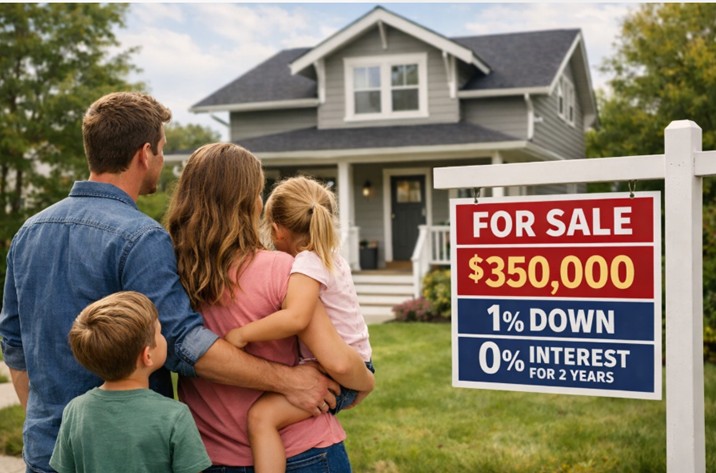
What if a developer designed an entire community and could build and sell brand-new, two-story, three-bedroom, two-bath homes for $350,000, and paired those homes with a financing structure that actually reflects how people live, earn, and stabilize financially over time?
Here’s the hypothetical that keeps popping into conversations lately:
- 1% down
- No closing costs
- Monthly PMI
- 0% interest for the first two years
- 2% interest for the next two years
- 4% interest for the following two years
- Then, beginning in year seven, the mortgage adjusts annually to the then-current market rate
- A full 30-year mortgage term
And now let’s add the missing piece that makes this scenario even remotely plausible:
Every one of those homes is built using offsite and modular construction.
Not experimental.
Not boutique.
Industrialized. Repeatable. Scalable.
So… what happens?
Demand Doesn’t Knock—It Kicks the Door In
If you could actually deliver this product—home and financing—demand wouldn’t creep in slowly. It would show up immediately and loudly.
Renters who have resigned themselves to “someday.”
Young families who can afford a monthly payment but not $25,000 in cash to close.
Older buyers downsizing but still wanting something new and predictable.
Teachers, nurses, municipal workers, tradespeople—the people every city claims it wants to house.
This isn’t about creating artificial demand. The demand already exists. What’s missing is an on-ramp.
And here’s where offsite construction matters.
Traditional site-built construction can’t ramp fast enough, consistently enough, or predictably enough to meet this kind of response without blowing budgets and schedules. Offsite and modular can—if they’re treated as manufacturing, not “construction done indoors.”
Factories thrive on:
- repetition,
- standardized details,
- predictable labor,
- controlled material usage,
- and reduced cycle times.
Those efficiencies don’t just shave weeks off schedules. They’re what make a $350,000 price point even thinkable in many markets.
The Price Pressure Nobody Likes to Talk About
Here’s the uncomfortable truth: affordability programs can actually push prices up if supply doesn’t keep pace.
If only one developer—or a handful—can offer this product, their communities become magnets. Nearby resale prices rise. Competing builders are forced to respond with rate buydowns or incentives they may not be able to sustain. Landowners notice and start asking more.

This isn’t speculation. We’ve seen versions of this play out repeatedly.
The difference here is that offsite construction offers a real chance to scale supply, not just stimulate demand. Modular factories can add shifts. Panel lines can be duplicated. Designs can be standardized across regions with local adaptations.
But only if local approvals don’t strangle the model before it takes root.
City Hall Won’t Fight the Mortgage—They’ll Fight Everything Else
Zoning officials aren’t going to argue about interest rates. That’s not their lane.
What they will push back on is:
- density,
- lot sizes,
- setbacks,
- parking ratios,
- traffic studies,
- school impact,
- stormwater,
- and “neighborhood character.”
If these homes look like “normal” single-family houses, resistance is muted—but not eliminated. If the community uses smaller lots, tighter setbacks, or shared infrastructure to make the math work, the pushback increases.
Ironically, cities will often say they support affordability in principle while quietly slowing down the very projects that could deliver it at scale.
Offsite construction doesn’t change that political reality—but it does expose it faster. Factories don’t idle gracefully. Delays cost real money, real fast.
And What About Codes and the Passive House Crowd?
Building code officials, for the most part, don’t care how cheap your financing is. They care about compliance, inspections, liability, and safety.
If modular or panelized systems are already approved, life is easier. If new systems or assemblies are introduced, expect a learning curve—and sometimes a slow walk.
As for the Passive House and high-performance advocates?
They’re not the enemy here. They’ll see this model and say, “Great—now don’t saddle homeowners with 30 years of high energy bills.”
That pressure will push for:
- tighter envelopes,
- better windows,
- improved ventilation,
- and verified performance.
That can add cost—or it can be absorbed through factory optimization and standardized detailing. Again, offsite construction is uniquely suited to deliver high performance consistently, not as a custom upgrade.
The Question Everyone Is Afraid to Ask: Is This 2008 All Over Again?
Any time you mention low down payments and teaser rates, someone brings up 2008. Fair enough.
But context matters.
The 2008 crisis wasn’t caused by affordability—it was caused by irresponsible underwriting, widespread speculation, and financial products that assumed housing prices could only go up.
The scenario described here only becomes dangerous if buyers are qualified based on the teaser payment instead of the future payment reality.
If lenders underwrite borrowers to handle higher payments—say at 4% or even higher—the risk drops dramatically. If buyers are counting on refinancing before rates adjust and that refinance never comes, risk increases.
Low down payment doesn’t automatically mean reckless. It does mean equity builds more slowly, which makes stable employment and conservative underwriting essential.
In other words, this model doesn’t create a housing crisis by default—but poor discipline could turn a good idea into a bad sequel.
Why Offsite and Modular Are the Quiet Linchpin
Without offsite construction, this entire concept collapses under its own weight.
You can’t promise predictable pricing without predictable production.
You can’t offer creative financing if construction timelines are a gamble.
You can’t scale affordability if every house is a one-off.
Factories don’t solve zoning.
They don’t solve land prices.
They don’t solve politics.
But they do solve consistency, speed, labor efficiency, and quality control—the things that quietly kill most affordable housing dreams long before ribbon cutting.
So What Happens If This Actually Works?
If done responsibly and at scale, this model could:
- pull thousands of households out of long-term renting,
- force competing builders to rethink pricing and incentives,
- pressure cities to reconcile stated housing goals with actual approvals,
- and elevate offsite construction from “alternative” to essential infrastructure.
It wouldn’t fix everything. No single idea ever does.
But it would change the conversation—from why affordable housing is impossible to why more people aren’t doing this.
And that’s a conversation worth having.
Two Questions I’ll Leave You With
If you were a renter today, would a brand-new modular home with this kind of financing finally make ownership feel attainable—or would the future rate adjustments scare you off?
And if you’re a city official, builder, or lender reading this: what part of this idea makes you most uncomfortable—the financing, the speed, or the fact that offsite construction might actually pull it off?
Because sometimes the ideas that make us uneasy are the ones that expose where the real bottlenecks have been hiding all along.
.
With more than 10,000 published articles on modular and offsite construction, Gary Fleisher remains one of the most trusted voices in the industry.
.
CLICK HERE to read the latest edition

Contact Gary Fleisher