


Whenever a site builder asks me why they should consider modular construction, I already know the real question hiding underneath.
They’re not asking about wall panels, marriage lines, or third-party inspections.
They’re asking one thing:
How does this make my business more profitable—and safer?
Most of the builders who ask have been around the block. They’ve framed homes in the rain. They’ve waited weeks for a subcontractor who promised to be there “next Tuesday.” They’ve absorbed surprise price increases and watched schedules unravel for reasons completely outside their control.
And yet, many of them still hesitate.
Not because modular doesn’t work—but because changing the way you build feels risky when the old way is familiar, even when it’s inefficient. What’s missing from the conversation isn’t another sales pitch. It’s an honest discussion about the intrinsic value modular construction brings to a builder’s operation—value that rarely shows up on a glossy brochure.
Waste Isn’t Just a Jobsite Problem—It’s a Business Problem
Jobsite waste has become so common that many builders barely notice it anymore. Dumpsters overflow. Scrap piles grow. Labor time disappears into cleanup.
In modular construction, that waste largely disappears—or gets repurposed.
Savings at the jobsite alone can reach staggering levels, sometimes approaching 75 percent. And contrary to popular belief, that waste isn’t simply shifted from the site to the factory. Most factories operate with a level of material discipline that site building simply can’t match.
Excess lumber becomes blocking and bracing. Scrap wood fuels heating systems. Drywall and cardboard are recycled. Very little ends up as true waste. That’s not just good for the environment—it’s good for margins.
Time Is the Only Resource You Never Get Back
From the moment a buyer signs a contract, both site builders and modular builders start on the same clock. Permits, financing, selections—it all takes about the same amount of time.
That’s where the similarity ends.
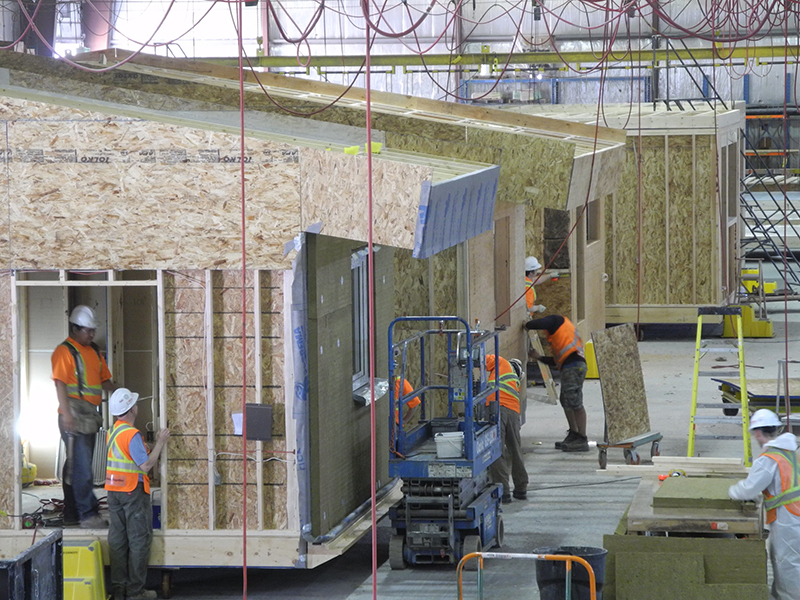
A traditional custom home often takes six to eight months after excavation. Modular construction compresses that timeline dramatically because the factory is building the home while the foundation is being prepared. When the modules arrive, much of the heavy lifting is already done.
What’s left is finish work—not months of exposure to weather delays, labor shortages, or rescheduling chaos.
Less time to completion means faster closings, improved cash flow, and fewer sleepless nights wondering what will go wrong next.
Predictability Is an Underrated Competitive Advantage
Rain doesn’t care about your schedule. Mud doesn’t respect deadlines. Inspectors don’t always arrive when promised.


Factories, on the other hand, operate in controlled environments. They can offer builders timelines that are far more reliable than anything a site can provide.
Things still happen—but fewer of them. And when your schedule is predictable, everything else improves: subcontractor coordination, customer communication, and overall stress levels.
That kind of predictability doesn’t just make building easier—it makes businesses stronger.
Labor Isn’t Coming Back the Way It Used To
The skilled labor shortage isn’t a phase. It’s a structural shift.
While overall housing activity has rebounded in fits and starts, skilled trades have not returned in meaningful numbers. Estimates suggest that only a fraction of experienced laborers from previous housing booms ever came back—and many never will.
Factories weathered those downturns differently. Their core workforce stayed intact. When new people are hired, they’re trained by experienced workers who know the process, the standards, and the expectations.
That continuity matters. It’s one of the quiet strengths of factory-built housing that doesn’t get nearly enough attention.
Innovation Shows Up Faster in a Factory
Site builders often learn about new products through lumberyards or subcontractors. That information arrives slowly and unevenly. Adding new options can be cumbersome.
Modular builders have an advantage most don’t recognize: the factory itself.
New products are vetted, priced, and added to standardized option lists. Builders benefit without having to chase information or negotiate every detail themselves. Often, a simple conversation with a factory rep triggers a cascade of answers—pricing, specs, availability—within days.
That speed keeps builders competitive without increasing their workload.
Inspections Without the Headaches
Every site builder has lived this nightmare: a failed inspection, a delayed subcontractor, and a second inspection scheduled weeks later.
Modular construction flips that equation.
Homes are inspected repeatedly during the build process—floor systems, framing, electrical, plumbing—by third-party inspectors before they ever leave the factory. Problems are identified and corrected immediately, not weeks later.
The result is fewer delays, fewer surprises, and more time spent doing what actually grows the business—selling homes and maintaining relationships.
Consistency Is the Foundation of Quality
Site building can be an adventure. Two homes, two crews, two outcomes.
Factories don’t work that way.
The same skilled people perform the same tasks using approved materials and standardized procedures. Quality becomes repeatable instead of accidental. Builders no longer have to wonder if two homes were built the same way—because they were.
Consistency isn’t boring. It’s profitable.
Predictable Costs Change Everything
Nothing disrupts a builder’s day like an unexpected price increase. Lumber jumps. Drywall spikes. Nobody calls.
With modular construction, pricing decisions happen upfront. Builders are notified in advance. Contracts are clear. And because modular construction accounts for a large portion of the total material cost, much of the price volatility is absorbed before the home ever reaches the site.
That kind of cost certainty allows builders to plan, price confidently, and protect margins.
It’s Not About Building Differently—It’s About Running a Better Business
Modular construction isn’t a silver bullet. It doesn’t eliminate risk. But it does reduce uncertainty—and in today’s market, that’s priceless.
For site builders still sitting on the fence, the real question isn’t whether modular works.
It’s whether continuing to build the same way—while costs rise, labor disappears, and schedules stretch—is the bigger risk of all.
Sometimes progress doesn’t require learning something new.
It simply requires letting go of what no longer serves the business.
And for many builders, that realization comes later than it should—but not too late to matter.
.
With more than 10,000 published articles on modular and offsite construction, Gary Fleisher remains one of the most trusted voices in the industry.
.
CLICK HERE to read the latest edition

Contact Gary Fleisher