




Big promises meet construction’s stubborn reality
When Big Numbers Start Doing the Talking
Every so often, an article comes along that makes you stop mid-sip of coffee—not because it’s insightful, but because it’s ambitious to the point of disbelief. The recent announcement from Low Carbon Construction plc about delivering one million homes certainly qualifies.
At first glance, it reads like exactly what the housing industry has been waiting for. Scale. Speed. Sustainability. A bold vision backed by financial markets and forward-thinking ideas.
And then you hit the numbers.
The Line That Changes Everything
Buried in the excitement is the sentence that should give every factory owner, builder, and developer pause:
“The plan proposes between 75 and 100 new large-scale communities nationwide, alongside 100 to 200 smaller urban extensions, supported by up to 1,000 ‘flying assembly factories’ operating concurrently.”
One thousand.
Not over a decade. Not gradually.
At the same time.
Meet the Company Behind the Vision
Before we go further, it’s worth taking a closer look at the company making this claim. You can explore their approach here: 👉 Visit Low Carbon Construction
Their model centers on what they call an “Offsite/Onsite” system—essentially temporary, site-based “flying factories” that assemble modules using components like Structural Insulated Panels (SIPs), aiming to reduce transport and improve efficiency.
It’s an interesting concept. In fact, they claim these temporary factories can produce multiple homes per week right on site.
But scaling that idea to 1,000 simultaneous operations? That’s where the conversation changes.
Let’s Talk About Reality for a Minute
The UK—and frankly most of the developed world—already struggles to meet housing targets using established builders, supply chains, and labor pools.
Now we’re being asked to believe that a relatively new construction model will not only scale—but explode—into a nationwide network of up to 1,000 active production units.
That’s not scaling.

That’s multiplying complexity at a level the industry has never seen.
Factories Don’t Just Appear
Let’s bring this down to the factory floor.
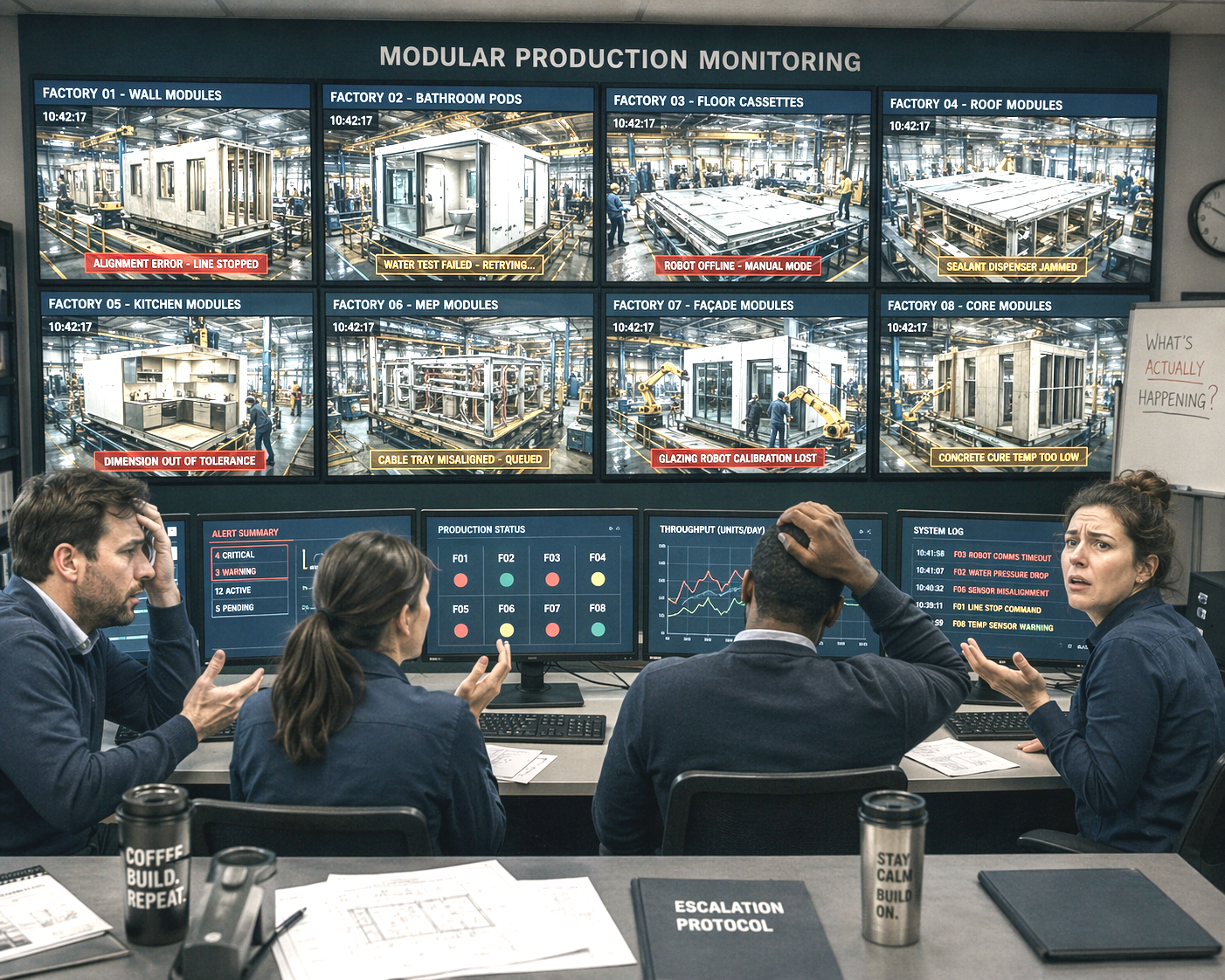
Each one of these “flying factories” is essentially a temporary production facility. That means tools, supervisors, logistics, quality control, scheduling, and trained labor—all duplicated hundreds of times over.
And according to the company’s own materials, each site-based factory would employ dozens of local tradespeople.
Multiply that by 1,000, and you’re not just building homes—you’re trying to mobilize an army.
Where does that workforce come from?
Because right now, most factories can’t even fully staff one location.
The Supply Chain Nobody Mentioned
Then comes the supply chain, which quietly makes or breaks every ambitious plan.
This model depends on delivering panels, materials, and finished components to each site-based factory, where they are assembled into modules and installed.
Now imagine coordinating that across 1,000 active sites.
One delay in materials doesn’t slow down one project—it ripples across dozens. Multiply that again, and suddenly your “flying factory” isn’t flying at all.
It’s waiting.
The Management Gap
Here’s something that rarely gets mentioned in press releases: leadership.
Running a single modular or panelized factory efficiently takes years of experience. Running ten takes an organization. Running 1,000 at the same time requires something the industry simply doesn’t have today—a deep bench of trained, experienced operational leaders ready to go.
You can build factories.
You can’t mass-produce leadership.
Vision vs. Execution
To be fair, the concept behind Low Carbon Construction plc isn’t without merit. Temporary on-site factories reduce transport, increase control, and potentially speed up delivery.
That part makes sense.
But there’s a wide gap between a working model on a handful of sites and a nationwide rollout involving 75–100 major communities, 100–200 urban extensions, and up to 1,000 concurrent factories.
That’s not evolution.
That’s a leap over several missing steps.
We’ve Seen This Before
The offsite industry has a long history of bold announcements. Modular was going to solve everything. Then panelization. Then 3D printing. Each brought innovation, but none delivered at the scale promised in their early headlines.
Not because the ideas were flawed.
Because execution is hard, slow, and unforgiving.
The Bigger Question
The real issue isn’t whether this plan is visionary.
It is.
The issue is whether it’s grounded in the realities of labor, logistics, leadership, and time.
Because in this industry, you don’t fail because of a lack of ideas.
You fail because the details don’t cooperate.
Modcoach Observation

I’ve watched factories struggle to add capacity, hire crews, and maintain quality with just one facility. So here’s my question:
Do you believe we’re on the verge of deploying 1,000 “flying factories”… or are we once again mistaking a compelling concept for something that can actually be built at scale?