






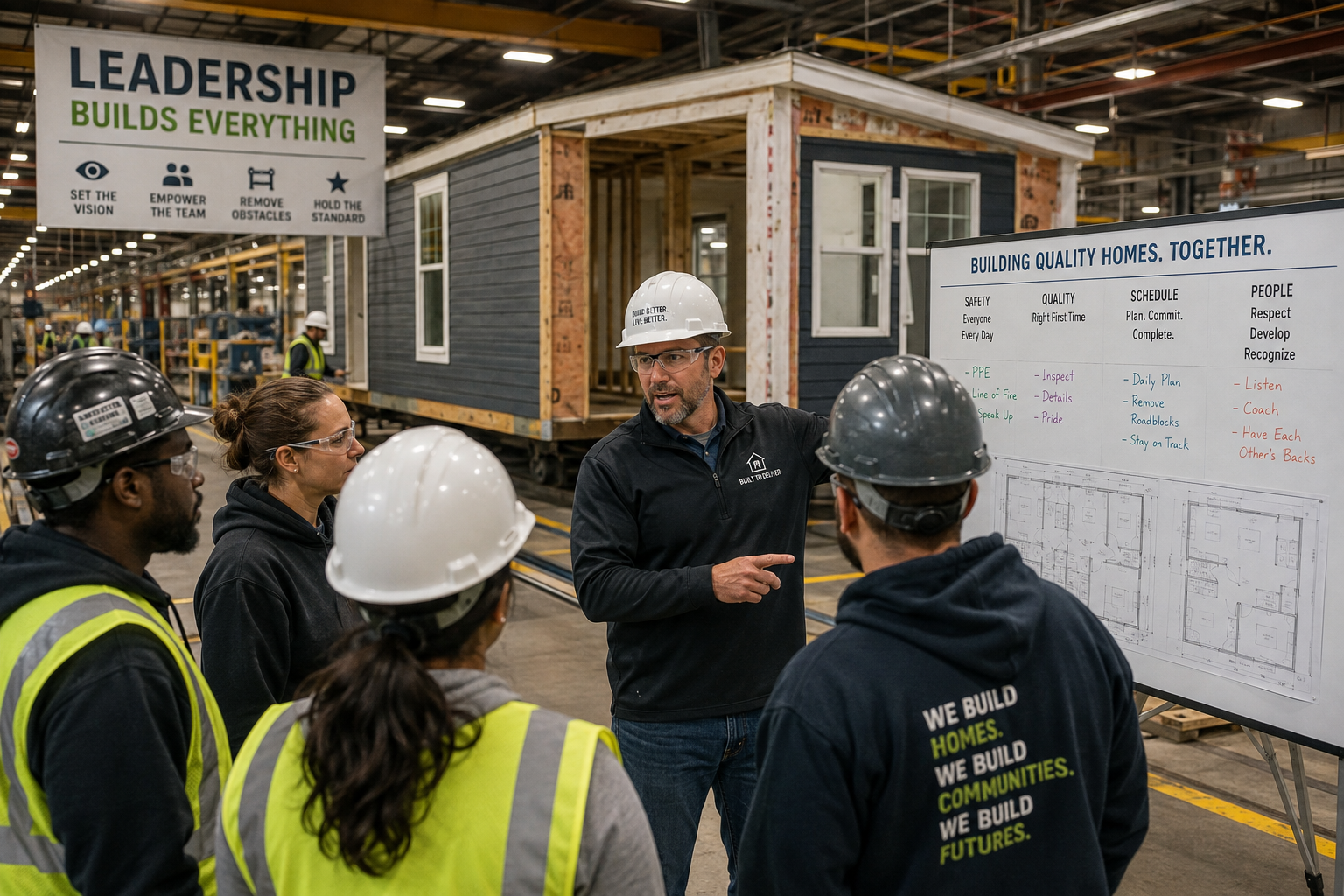
I have walked through enough offsite factories to know that every company has a leadership culture, even if nobody has ever tried to define it. You can see it in the way production workers respond when a problem appears on the line, hear it in how department managers talk about one another, and feel it when a customer calls about a late project, an engineering mistake, or a module that arrived at the jobsite with something wrong.
Some factories have a culture in which people step forward, solve the problem, and learn from it. Others have a culture in which everyone immediately begins explaining why it was somebody else’s fault. That difference does not begin on the production floor. It begins at the top.
Owners and senior managers often talk about wanting accountability, better communication, innovation, and teamwork. Those words appear in employee meetings, company newsletters, and mission statements, but employees do not judge leadership by what is written on the wall. They judge it by what leaders tolerate, reward, ignore, and do when the pressure is on. That is where a company’s real leadership culture is revealed.
Leadership Is More Than Keeping Production Moving
Offsite construction combines manufacturing, engineering, transportation, construction, sales, code compliance, purchasing, and customer service under one roof. Every department depends on several others doing their jobs correctly and on time. That interdependence is one of the industry’s greatest strengths, but it is also one of its greatest vulnerabilities.
A sales promise can create an engineering problem. An engineering delay can interrupt purchasing, a purchasing shortage can stop production, and a production mistake can quickly become a transportation or jobsite problem. When it finally reaches the builder or developer, the customer does not care which department caused it. The customer sees only one thing: the factory failed to deliver what it promised.
Leadership cannot exist only in the front office. It must reach engineering, sales, purchasing, production, quality control, transportation, service, and the jobsite. If every important decision must go back to the owner or general manager, the company may have plenty of managers but very few actual leaders.
That type of company may operate reasonably well when business is predictable. It will struggle, however, when schedules tighten, orders slow, cash becomes scarce, or a major customer begins demanding answers. A true leadership culture produces people who can recognize problems, make sound decisions, and accept responsibility without waiting to be rescued from above.
Stop Promoting People and Hoping They Become Leaders
One of the most common mistakes in offsite construction is promoting the best technician into management without preparing that person to lead. The best carpenter becomes a production supervisor, a talented designer becomes the engineering manager, or a successful salesperson becomes the sales manager. Each may understand the technical side of the job exceptionally well, but technical ability does not automatically produce leadership ability.
Managing people requires a different set of skills. New managers must learn how to set expectations, resolve conflict, correct poor performance, communicate unpopular decisions, and hold people accountable without humiliating them. They also need to understand when to make a decision on their own and when to ask for help.
Too many companies hand someone a new title, a small raise, and a collection of problems their predecessor never solved. Six months later, senior management is disappointed that the person has not “stepped up.” That is not leadership development. It is abandonment disguised as opportunity.
If a company wants stronger leaders, it must deliberately build them through coaching, mentoring, training, and progressively greater responsibility. Leaders are often discovered through experience, but they are developed through attention. The process takes time, and it requires senior leaders who are willing to teach rather than simply criticize.
Accountability Must Begin at the Top
Owners frequently say they want employees to accept accountability. What they sometimes mean is that they want employees to accept responsibility for mistakes while ownership takes credit for success. Employees notice that contradiction very quickly, and they adjust their behavior accordingly.
If the owner blames the market, the sales team, the workforce, the weather, the lender, or the customer every time something goes wrong, managers will learn to do the same. Blame travels downhill faster than responsibility, and before long, every department will have a carefully prepared explanation for why another department caused the problem.

Accountability does not mean creating a workplace in which people are afraid to admit mistakes. Fear usually causes mistakes to remain hidden until they become more expensive. A healthy leadership culture allows someone to say, “I made the wrong decision,” or “We have a problem,” without assuming the admission will end a career.
The emphasis should be on correcting the immediate issue, understanding why it happened, and preventing it from happening again. That standard must apply equally to the production worker, department manager, general manager, and owner. When senior leaders openly acknowledge their own mistakes, they give everyone else permission to tell the truth.
Some owners may view that openness as a sign of weakness. In reality, it is one of the foundations of operational strength because a company cannot correct problems its people are afraid to discuss.
Listen to the People Closest to the Problem
Some of the best operational information in a factory never reaches the conference room. The person installing windows may know a particular opening is repeatedly out of square. A forklift operator may see material being handled three times when it should be handled once, while a service technician may recognize that the same field problem has appeared in five different projects.
These people may not have management titles, but they possess knowledge leadership cannot afford to ignore. A title does not always indicate who understands a problem best. In many cases, the employee performing the work every day sees trouble long before it appears on a spreadsheet or monthly report.
Inviting feedback is only the first step. Management must also do something with it. Nothing destroys trust faster than asking employees for ideas, holding a meeting, taking notes, and allowing every suggestion to disappear.
After that happens several times, people stop speaking up. Management then concludes that employees are not engaged, when the truth is that employees have learned that engagement accomplishes nothing. They may continue doing their jobs, but they will keep their observations and ideas to themselves.
Not every suggestion will be practical, but every serious suggestion deserves a response. People should know whether the idea will be tested, delayed, modified, or rejected, along with the reason for the decision. Listening without responding is not communication. It is theater.
Leadership Is Tested When Conditions Change
It is easy to look like a strong leader when the backlog is full, cash is flowing, and the production schedule is manageable. The real test comes when orders slow, a major project is delayed, material costs rise, a customer refuses payment, or the company needs another cash call. Those are the moments when employees watch leadership most closely.
Do leaders communicate honestly, or do rumors become the primary source of information? Do they protect favored employees while cutting everyone else? Do they continue blaming the sales department for weak demand, or do they examine the company’s products, pricing, reputation, market position, and customer experience?
Strong leaders do not pretend everything is fine when it clearly is not. They explain what is happening, what is known, what remains uncertain, and what the company is doing next. That does not mean sharing every confidential financial detail, but it does mean treating employees like adults who deserve an honest understanding of the situation.
Employees can handle difficult news better than many owners believe. What they cannot handle for long is sensing that something is wrong while leadership insists there is nothing to worry about. Silence does not protect morale. It allows fear and rumors to create their own version of the future.
Recognition Must Be Credible
Employee recognition can strengthen a leadership culture, but only when employees believe it is sincere. A “Leader of the Month” plaque means very little if the same dependable people are continually overlooked while recognition goes to whoever is most visible to management. A social media post praising an employee cannot compensate for years without meaningful feedback, training, or opportunity.
Real recognition is specific. It explains what the person did, why it mattered, and how that behavior reflects the company’s standards. It should reinforce the type of leadership and performance the company wants others to follow.
Recognition can include public acknowledgment, additional responsibility, professional development, mentoring opportunities, or a clear path toward advancement. Sometimes the most meaningful recognition is simply a senior manager taking the time to say, “I saw what you did, and it made a difference.”
Companies such as Simplex Homes and Autovol have used social media to recognize employee accomplishments. That public acknowledgment can build pride, but it is most effective when it reflects what employees already experience inside the company. Culture cannot be repaired by posting photographs of smiling workers if those workers do not feel respected after the camera is gone.
Measure What Leadership Produces
Leadership culture should eventually appear in company performance. It should show up in employee retention, fewer production mistakes, reduced rework, better communication between departments, improved schedule reliability, stronger safety performance, and fewer surprises reaching the jobsite.
Management should also watch for less obvious signs. Are employees willing to raise concerns earlier? Are department managers solving problems together instead of protecting their own territories? Are promising employees asking about advancement, or are they quietly looking elsewhere?
Another revealing question is whether the factory can operate effectively when the owner or general manager is away. If everything slows down, decisions stop, and managers begin waiting for permission the moment the owner leaves the building, the company has built dependency rather than leadership.
A strong leader should not be trying to make himself or herself indispensable to every daily decision. The real goal should be to develop a team that understands the company’s standards and can operate responsibly without constant intervention from the top.
Gary’s Observation

Leadership culture is not another program to introduce at the next employee meeting. It is the accumulated result of hundreds of decisions, reactions, conversations, promotions, corrections, and missed opportunities. Employees are constantly watching to see who receives credit, who accepts blame, whose ideas are heard, which mistakes are forgiven, and which behaviors are allowed to continue.
Owners sometimes believe they can assign responsibility for culture to human resources or a new leadership committee. They cannot. The owner and senior management team are already teaching the company how to lead every day, whether they realize it or not. The only question is whether they are teaching the right lessons.
Offsite construction needs better technology, stronger systems, and more efficient processes, but none of those will save a company whose people are afraid to speak, whose managers refuse responsibility, or whose owner has become the only person permitted to make a meaningful decision. Technology can improve production, but it cannot correct a leadership culture built around fear, blame, and dependency.
A strong leadership culture becomes evident when people throughout the company are both willing and prepared to step forward before a small problem becomes an expensive one. That is when leadership stops being a title handed out by management and becomes part of how the entire company operates.