
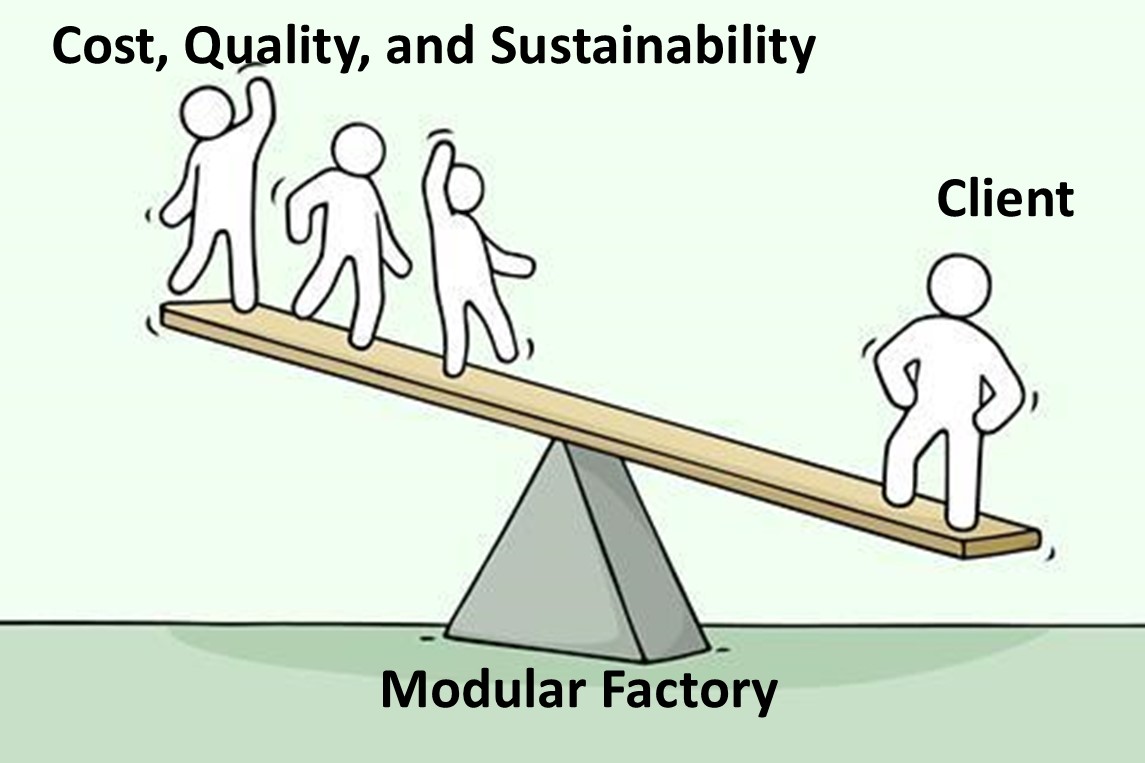
In modular construction, striking the right balance between cost, quality, and sustainability is crucial for both the factory and the client. As factories build estimates for production and prepare quotes, understanding these trade-offs becomes essential.
.
Here’s a straightforward look at how modular factories can navigate this balancing act.
Understanding the Trade-offs
When managing a modular construction project, you’ll often face trade-offs between cost, quality, and sustainability. Each of these elements impacts the others, and finding the right balance is key to satisfying your clients while maintaining your bottom line.
Cost vs. Quality: Lowering costs often means using cheaper materials or speeding up production, but this can lead to compromised quality. For example, inexpensive materials may not be as durable or aesthetically pleasing, and rushing production can result in subpar workmanship. On the other hand, high-quality materials and meticulous craftsmanship inevitably increase costs. Balancing these factors involves finding materials and methods that provide the desired quality without exceeding budget constraints.
Cost vs. Sustainability: Sustainable practices, like using eco-friendly materials or reducing waste, might initially seem more expensive. For instance, sustainable materials such as bamboo or reclaimed wood can be costlier than conventional options. However, these practices can lead to long-term savings through energy efficiency, reduced waste disposal costs, and potentially lower regulatory fees. Evaluating the long-term financial benefits alongside the initial costs can help find a balance.
Quality vs. Sustainability: High-quality materials can sometimes be less sustainable. For instance, some durable materials might have a large carbon footprint or involve environmentally harmful manufacturing processes. Balancing this means finding materials that offer both durability and a lower environmental impact. For example, Cross-Laminated Timber (CLT) is both durable and more sustainable compared to traditional steel or concrete.
Setting Priorities
Every project is unique, and priorities can vary based on the client’s needs and values. Some clients might prioritize cost over quality, while others might be willing to pay more for sustainability. Understanding the client’s priorities is the first step in finding the right balance.
Ask Questions: Engage with builders and developers to understand their priorities. Are they more concerned with upfront costs, long-term quality, or the environmental impact of their home? For instance, a builder’s client planning to live in the home for decades may prioritize quality and sustainability over initial cost savings.
Educate Clients: Often, clients might not be aware of the benefits of investing in quality and sustainability. Educate them on how these investments can lead to long-term savings and benefits. For example, explain how better insulation and energy-efficient windows can significantly reduce utility bills over time, offsetting the higher initial costs.
Making Informed Choices
Material Selection: Choose materials that offer a good balance between cost, quality, and sustainability. For example, using recycled steel can be both cost-effective and sustainable while still offering high quality. Investigate various materials and their properties to make informed decisions that align with your client’s priorities.
Efficient Production Techniques: Implementing efficient production techniques can help reduce costs without compromising quality or sustainability. For instance, precision cutting reduces waste by ensuring that materials are used more efficiently. Energy-efficient machinery lowers both costs and environmental impact by consuming less power and reducing emissions.
Innovative Solutions: Explore innovative solutions that offer dual benefits. For instance, using advanced insulation materials can improve energy efficiency (sustainability) and reduce heating/cooling costs (quality). Look for technologies and methods that enhance both sustainability and the overall quality of the build.
Transparency with builders and developers
Being transparent with clients about the costs and benefits of different choices is crucial. Provide detailed estimates that break down the costs associated with different materials and methods, and explain the long-term benefits of investing in quality and sustainability.
Detailed Estimates: Break down the costs associated with various choices. Show clients how different materials and techniques impact the overall cost, quality, and sustainability of their home. For example, a detailed estimate might show the cost differences between standard insulation and high-efficiency insulation, along with the expected energy savings over time.
Long-term Benefits: Highlight the long-term benefits of quality and sustainability. For example, a higher upfront cost for better insulation can lead to significant savings on energy bills over time. Explain how sustainable materials can increase the home’s value and reduce maintenance costs in the long run.
Continuous Improvement
Finally, always strive for continuous improvement. Stay updated with the latest in sustainable materials and production techniques. Regularly review and refine your processes to ensure you’re offering the best balance of cost, quality, and sustainability.
Stay Updated: Keep abreast of the latest advancements in materials and technology. New innovations can offer better solutions that improve the balance between cost, quality, and sustainability. Attend industry conferences, subscribe to relevant publications, and network with other professionals to stay informed.
Review and Refine: Regularly review your processes and gather feedback from clients. Use this information to refine your methods and improve your offerings. For instance, conduct post-project reviews to identify areas where cost savings could be achieved without compromising quality or sustainability.
Modcoach Thoughts
Balancing cost, quality, and sustainability in modular construction is not a one-size-fits-all approach. It requires understanding the client’s priorities, making informed choices, being transparent, and continually improving. By focusing on these areas, modular factories can deliver homes that meet clients’ needs while also being cost-effective, high-quality, and environmentally friendly. Through careful planning and a commitment to innovation and transparency, modular construction can provide a balanced and sustainable solution for modern housing needs.
.

CLICK HERE to read the latest edition

Contact Gary Fleisher