





The Offsite industry has an opportunity to solve one of housing’s biggest challenges.
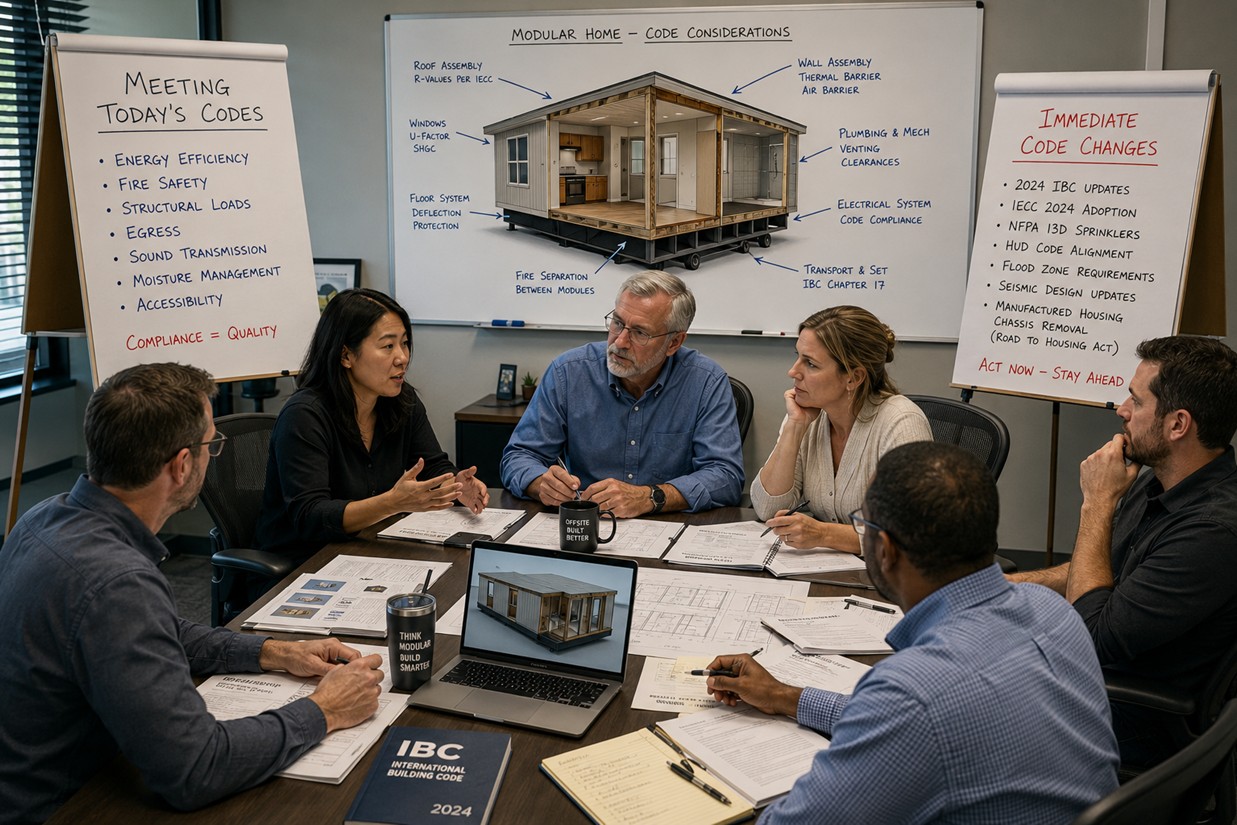
Every year, building a new home seems to become a little more expensive. Rising material costs, labor shortages, financing, land prices, and insurance premiums all play a role. Yet another contributor often receives far less attention: the growing number of building codes and regulations that new homes must meet before a family can move in.
Building codes are not the enemy. In fact, they’ve saved countless lives over the decades by making homes stronger, healthier, and better prepared to withstand disasters. The challenge is that every new requirement, no matter how well-intended, carries a cost. As those costs accumulate, they push homeownership farther out of reach for the very families these regulations are designed to protect.
That raises a question for the Offsite construction industry that warrants serious discussion. How can we continue building safer, more resilient homes while keeping them affordable for working Americans?
Better Codes Have Made Better Homes
Today’s homes are dramatically different from those built fifty years ago. Modern construction incorporates stronger structural systems, improved electrical and plumbing standards, better insulation, enhanced ventilation, safer materials, and far more rigorous engineering.
Communities that have experienced hurricanes, wildfires, earthquakes, floods, and other natural disasters have learned painful lessons. In many cases, those experiences led to stronger building requirements that now help protect both lives and property.
Few people would argue that homes should be less safe. The real challenge is finding ways to deliver those improvements without adding so much cost that fewer people can afford to buy a new home.
Some States Face Greater Challenges Than Others
Not every state faces the same environmental risks, and not every state has adopted the same level of building regulations.
Some have gone well beyond the national model building codes by adopting additional state or local requirements tailored to their unique conditions. California has become known for its extensive wildfire protections, seismic standards, and demanding energy-efficiency requirements. Washington, Oregon, Massachusetts, New York, Hawaii, and many communities throughout Colorado have adopted aggressive energy-performance and climate-resiliency standards that often exceed the national minimums. Along the East Coast, states such as Maryland and Virginia have implemented additional stormwater management and environmental regulations in many jurisdictions.
Meanwhile, Florida and Louisiana have developed some of the country’s toughest structural building requirements because repeated hurricanes have underscored the importance of designing homes to withstand extreme wind events. Those stronger standards have unquestionably improved building performance during storms, but they also increase construction costs.
None of these states adopted stronger standards without good reason. Their regulations reflect the unique challenges their residents face. The issue isn’t whether safer homes should be built. The issue is whether those homes remain affordable after each new requirement is added.
For many families, the answer is becoming increasingly difficult.
The Families Caught in the Middle
The housing crisis isn’t limited to lower-income households.
Across the country, there are teachers, police officers, nurses, firefighters, skilled tradespeople, office workers, and young families who earn respectable incomes yet still cannot afford a newly built home. They often earn too much to qualify for assistance programs, yet not enough to comfortably afford today’s construction costs.

As new regulations continue to raise housing costs, many buyers remain in older homes that may be less safe, less energy-efficient, and more expensive to maintain.
That outcome benefits no one.
This Is Where Offsite Construction Can Lead
Rather than viewing the expansion of building codes as another obstacle, the Offsite industry has an opportunity to demonstrate why factory-built construction is uniquely positioned to meet the challenge.
Factories operate in controlled environments where materials are protected from the weather, production follows repeatable processes, and quality control is far more consistent than on most traditional job sites. Bulk purchasing reduces material costs. Precision manufacturing minimizes waste. Specialized crews perform the same tasks repeatedly, improving both efficiency and workmanship.
These advantages don’t eliminate the additional cost created by stricter regulations, but they do provide opportunities to offset those increases more effectively than many conventional building methods.
That’s a conversation worth having.
Standardize the Engineering, Not the Home
One of the biggest misconceptions about Offsite construction is that standardization means every home has to look alike.
Nothing could be further from the truth.
The real opportunity lies behind the finished walls. Manufacturers can develop standardized structural systems, wall assemblies, roof designs, floor systems, and engineering packages that satisfy combinations of fire resistance, flood protection, hurricane requirements, seismic standards, and energy-performance codes.
Instead of redesigning similar homes over and over again, factories could adapt proven engineering solutions to meet the specific requirements of different markets.
The customer still receives a customized home. The factory simply builds it more efficiently.
Collaboration Can Lower Costs
Another challenge facing the industry is the lack of consistency between jurisdictions.
Manufacturers often discover that neighboring cities or counties interpret the same building code differently or adopt their own amendments. That forces engineers to repeatedly modify plans, adding time and expense before construction even begins.
Greater collaboration among manufacturers, engineers, suppliers, transportation companies, and code officials could produce standardized solutions that reduce duplication while maintaining safety.
Lower engineering costs eventually translate into lower housing costs.
Transportation Is Part of the Solution
Building an affordable home inside a factory is only part of the equation. It still has to reach the jobsite economically.
Innovations in transportation systems, carrier technology, structural framing, and logistics are creating new opportunities to reduce delivery costs while expanding the geographic reach of modular manufacturers. As transportation becomes more efficient, factories can serve larger markets without adding excessive shipping expenses to the final selling price.
Every improvement made after a home leaves the factory helps preserve affordability for the buyer.
The Goal Should Be Both Safety and Affordability
The housing industry has accomplished remarkable things over the past several decades. Today’s homes are stronger, healthier, and more resilient than ever before.
Now the challenge is making sure those same homes remain within reach of ordinary working families.
Safety should never become a luxury.
Neither should homeownership.
Those two goals should work together, not compete against one another.
Gary’s Observation

I’ve spent decades talking with factory owners, builders, developers, suppliers, engineers, and housing professionals, and one thing has become clear to me. We spend far too much time debating whether building codes have gone too far and not nearly enough time figuring out how to build homes that meet those standards more efficiently.
The Offsite industry has always claimed it can build better. Here’s our opportunity to prove it.
Instead of arguing against stronger codes, let’s demonstrate that factory-built housing can deliver homes that are safer, more resilient, better engineered, and still affordable for working families. If we can do that consistently, we won’t just be competing with site builders. We’ll be setting the standard for how America addresses its housing shortage in the decades ahead.
That’s a future worth building.