


The housing industry spends an enormous amount of time trying to figure out how to build more affordable homes. We debate smaller floor plans, denser communities, lower-cost materials, and faster construction methods. Yet despite all of those conversations, millions of young adults still find themselves priced out of homeownership and increasingly frustrated by rising apartment rents.
Maybe we’re asking the wrong question.
Instead of asking how to make traditional housing more affordable, perhaps we should be asking whether younger generations are looking for a different kind of housing altogether.
That is where coliving enters the conversation.
For those unfamiliar with the term, coliving is a modern housing concept where residents have private bedrooms and often private bathrooms while sharing common spaces such as kitchens, dining areas, lounges, laundry facilities, outdoor gathering spaces, and even coworking areas.
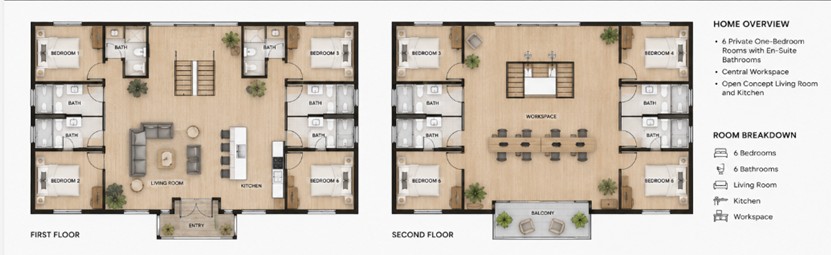
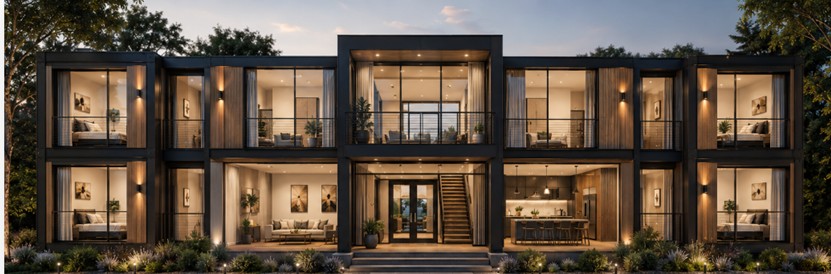
Designed by Gary Fleisher
To some people, it sounds revolutionary.
To others, especially those of us who remember workforce housing, boarding houses, and rooming houses, it sounds surprisingly familiar.
The difference is that today’s version is being designed specifically for Generation Z, a generation facing housing costs and economic pressures unlike anything previous generations experienced at the same age.
For developers and modular factories, that reality may be creating one of the most attractive housing opportunities to emerge in years.
The Return of Workforce Housing
Long before starter homes became the goal for every young family, workforce housing filled an important role throughout America.
Mill workers, factory employees, teachers, salespeople, and young professionals often rented rooms in larger homes. They had their own private space but shared kitchens, dining rooms, and other common areas. It wasn’t considered unusual. In many communities, it was simply the next step after leaving home.

Over time, those housing options largely disappeared.
Zoning regulations changed. Expectations changed. The American Dream evolved into homeownership, and anything short of that began to feel like a temporary solution rather than a legitimate housing choice.
Fast forward to today.
A growing number of young adults find themselves paying high rents, carrying student debt, changing jobs more frequently, and delaying major life decisions. For many, purchasing a home feels less like a milestone and more like a distant aspiration.
At the same time, many younger people place greater value on flexibility, mobility, and community than previous generations.
In many ways, the market conditions that once made workforce housing successful are returning.
The housing industry simply gave it a new name.

Why Developers Are Going to Love It
Developers are constantly looking for projects that make financial sense while serving a real market need.
Coliving checks both boxes.
Consider an eight-bedroom home designed specifically for shared living. Each resident has a private bedroom and private bath. The common areas are designed to encourage interaction, collaboration, and convenience.

For residents, housing costs are substantially lower than leasing an individual apartment.
For developers, the economics can become extremely attractive.
A property that might traditionally serve a single family can potentially generate revenue from multiple residents. Shared utilities, maintenance costs, and common amenities create operational efficiencies while increasing overall revenue potential.
Even more important, the target demographic already exists.
Developers don’t need to convince Gen Z that housing is expensive. They live that reality every day. They don’t need to convince young professionals that flexibility has value. Many already prioritize location and affordability over ownership.
What developers need is a housing product that aligns with those preferences.
Coliving may be exactly that product.
Why Offsite Construction Has the Advantage
This is where the story becomes especially interesting for modular and offsite manufacturers.
Factories thrive on repetition.
They perform best when producing standardized designs that can be built repeatedly with predictable labor, predictable materials, and predictable schedules.
Coliving communities fit that model perfectly.
Imagine a developer planning dozens of six-bedroom coliving homes within a single community. The floor plans remain largely consistent. Bathroom layouts repeat. Mechanical systems repeat. Structural designs repeat.
That level of standardization creates efficiencies that conventional site builders often struggle to achieve.
The speed advantage may be even more important.
Housing shortages continue to grow in many markets. Developers want projects completed faster. Municipalities want housing delivered faster. Investors want returns faster.
Modular factories can help satisfy all three demands simultaneously.
Instead of waiting months for weather delays, labor shortages, and scheduling conflicts to work themselves out, factory-built coliving units can move through production in a controlled environment while site work occurs simultaneously.
The result is a housing product that can be delivered more quickly and more predictably than many conventional alternatives.
Perhaps the most exciting aspect is that factories don’t need to reinvent themselves to pursue this market.
They already possess the skills, equipment, workforce, and production knowledge necessary to build these structures today.
The Challenge and the Opportunity
As with many promising housing concepts, the greatest obstacle may not be construction.
It may be regulation.
Many zoning ordinances were written for a different era. Housing was generally categorized as single-family homes, apartments, duplexes, or condominiums. Coliving doesn’t always fit neatly into those categories.
Questions about occupancy limits, parking requirements, density calculations, and permitting standards can quickly emerge.
Developers may find themselves spending as much time educating local officials as they do attracting investors.
For those of us in offsite construction, that sounds very familiar.
The industry has spent decades proving that manufacturing technology often advances faster than regulations. Time and again, factories have demonstrated their ability to solve housing challenges while local codes and zoning ordinances struggle to keep pace.
Yet that challenge may also represent the opportunity.
Beneath the modern branding and technology, coliving is really a modernized version of workforce housing. It addresses affordability without sacrificing privacy. It encourages community without requiring homeownership. It creates flexibility without forcing people into expensive apartments.
Most importantly, it fills a housing gap that has grown larger every year.
Young adults need an option between living with their parents and purchasing a home.
Coliving may be that option.
And if it is, developers and modular manufacturers could find themselves standing at the front edge of a rapidly growing market.
Modcoach Observation

The housing industry has spent years trying to build yesterday’s dream more efficiently. Coliving asks a different question: What if today’s young adults want something different altogether? To me, this looks less like a trend and more like the return of workforce housing dressed in modern clothes. If developers embrace it and modular factories recognize how perfectly suited they are to produce it, coliving could become one of the most important housing products of the next decade.