





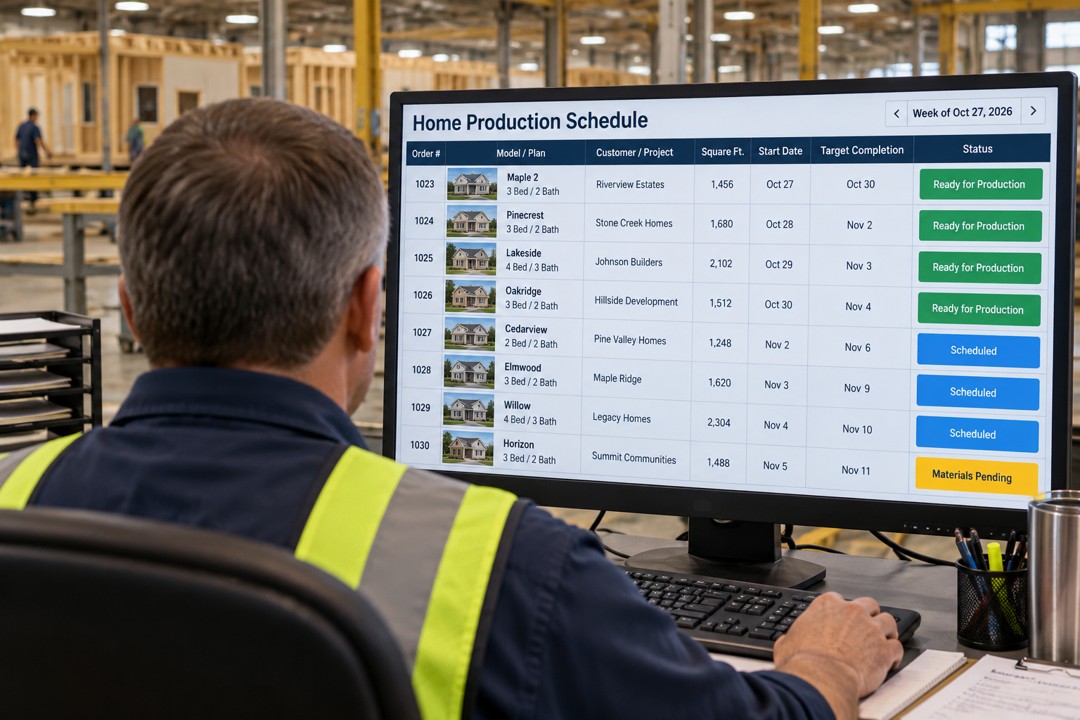
In a modular factory, a delivery problem can quickly become everyone’s problem. Purchasing gets word that the windows will arrive three days late. Production looks at the schedule. Sales remembers the delivery date promised to the builder. Someone suggests moving another house ahead, and suddenly a decision that sounded simple requires a conversation with half the office.
I believe this is one of the most useful places to examine artificial intelligence in offsite construction. A factory manager needs to understand what each possible change will do to the rest of the operation. AI-assisted planning lets you compare those consequences while you still have time to make a better decision.
A Schedule Has to Reflect the Work
Putting four modules on Monday’s schedule does not tell us everything we need to know about Monday. Those modules might contain kitchens, bathrooms, complicated mechanical systems, or relatively straightforward living spaces. They may occupy similar amounts of floor space while requiring very different amounts of labor at individual stations.
That difference matters when a factory tries to maintain a steady production pace. Moving several labor-intensive modules through the same department in succession can create a backup that affects everyone behind them. The schedule may look reasonable in modules per day, yet become difficult to execute when measured by the work each crew must finish.
An experienced production manager recognizes many of these conflicts. AI can support that judgment with information from previous jobs: how long particular assemblies took, which features added work, and where actual production times consistently differed from estimates.
There is research behind this approach. A 2023 study applied machine learning and scheduling optimization to a wood-based wall-panel production line at a modular fabricator in Edmonton. The method used historical information to predict processing times, then used those predictions to develop component sequences. That is a specific application with a defined purpose, and it gives us a more useful starting point than a sweeping claim that AI can run an entire factory.
Three Houses and One Difficult Decision
Let’s consider a hypothetical factory with three houses approaching production. House A has the delayed windows. House B has its materials available but requires considerable plumbing work. House C is relatively straightforward to build, with materials ready, but its foundation will not be ready for another two weeks.
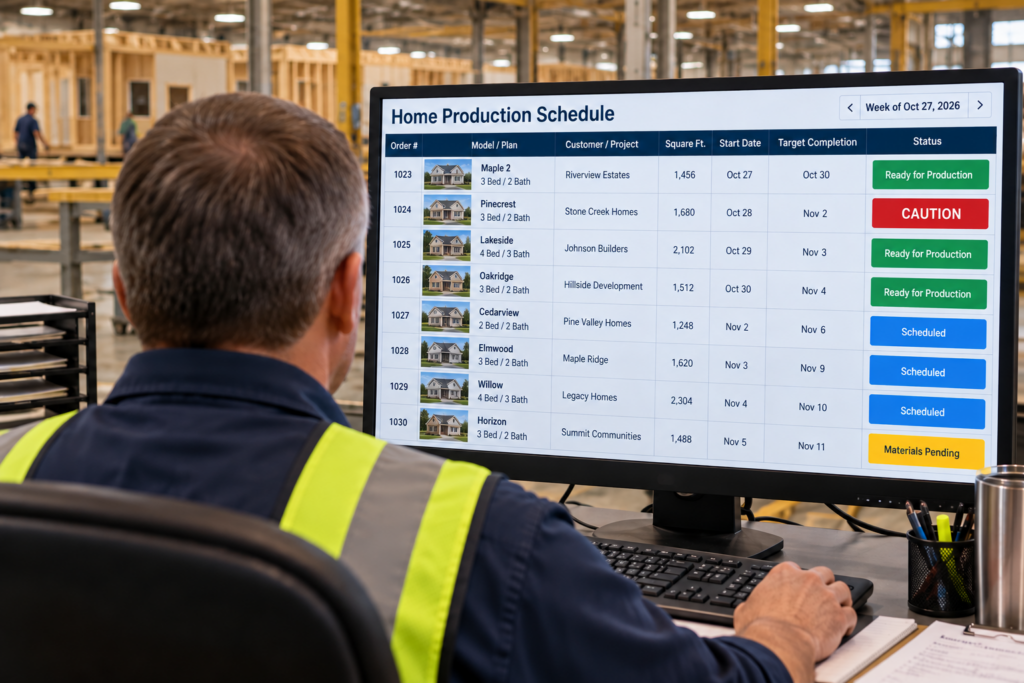
Moving House C ahead might keep the line working smoothly. However, management also needs to consider where its completed modules will sit, whether they will occupy needed transportation equipment, and how much additional handling they may require. A convenient production decision could create a storage problem.
House B presents a different tradeoff. It may be ready to build, but moving it forward could place too much work on the plumbing crew at exactly the wrong time. Continuing House A could also be possible, provided the factory’s approved procedures allow later window installation and the remaining work can be completed without compromising access, protection, quality, or inspection requirements.
These are the kinds of choices an AI-assisted planning system could help evaluate. It would need the factory’s actual operating rules and limitations. Otherwise, it might recommend something that looks efficient on a screen but cannot reasonably be done on the floor.
Looking Beyond the Immediate Fix
What interests me is the chance to examine several alternatives before committing to one. The manager could compare holding House A, advancing House B, advancing House C, or paying to expedite the windows. Each choice would have different implications for labor, completion dates, storage, handling, and delivery.

The recommendation should explain its conditions. For example, a hypothetical system might conclude that moving House B ahead is workable only if additional qualified plumbing labor is available Tuesday. Without that labor, the change could delay the next house.
That explanation is essential. A production manager needs to know why a proposed schedule works, what information supports it, and what could cause it to fail. A recommendation built on an unconfirmed delivery or an unavailable crew should make that dependency clear.
The manager would still make the decision. The benefit is having more consequences visible before the decision reaches the production floor.
“On Order” Does Not Mean Ready for Production
Material planning is closely connected to this discussion because a schedule is only as dependable as the material information supporting it. A considerable difference exists between an item being ordered, confirmed, shipped, received, inspected, and available for a specific job.
Windows in receiving may be damaged. Cabinets listed in inventory may already be assigned to another house. A substitute product may be physically available while still awaiting approval. If the planning system treats all of those situations as “material available,” its recommendations will be unreliable.
A useful system would connect each critical material to the operation that needs it. Some materials are required when production begins. Others are needed later. Moving a house forward should trigger a review of whether its materials can reach the appropriate stations when required.
Moving a house back should prompt another question: can you adjust any upcoming deliveries without creating a future shortage? There may be opportunities to reduce unnecessary storage and the amount of cash tied up in material waiting for use. Those opportunities depend on supplier terms, delivery flexibility, and the risk of losing a dependable delivery slot.
Traditional material-planning software already handles portions of this work. AI can add predictions about processing times or supply risks, while scheduling software evaluates alternative sequences. Factory owners should ask exactly what an AI feature contributes to the decisions they need to make.
Planning for the Delivery That Might Slip
A promised delivery date deserves attention, but it shouldn’t be treated as certain. With adequate historical records, a predictive system could examine patterns in supplier delivery performance and help management test different scenarios.
What happens if the windows arrive as promised? What changes if they are two days late? What if only part of the order arrives? These questions give management a chance to see how well a schedule holds up under ordinary disruptions.
I would rather see a factory understand where its schedule can absorb a problem than discover every weakness as the week unfolds. Knowing which delivery is truly critical and which delay can be accommodated without affecting the customer has value.
Predictions would still have limits. A supplier’s past performance cannot guarantee its next shipment. The useful output is an informed assessment of uncertainty, supported by current information and revised when conditions change.
The Building Itself Sets Limits
Any scheduling proposal must respect the physical factory. Can modules pass one another? Is there a separate completion area? Can equipment reach an unfinished module once it has been moved aside? Are qualified workers available to return to the remaining work?
These details determine which options are realistic. A factory with a fixed production line and limited space may gain the most by improving the sequence before modules enter production. Once work begins, the choices can become much narrower.
Transportation and site readiness belong in the same discussion. Research on modular project scheduling has explicitly considered factory production, transportation, and erection together, including limited resources and required sequences. That is a useful reminder that finishing a module is one part of fulfilling a customer’s order.
For our hypothetical House C, the foundation delay should be visible when the production decision is made. Otherwise, the factory could improve this week’s production numbers while creating next week’s yard problem.
Deciding What a Better Schedule Means
Before adopting a scheduling system, management needs to define the results it wants. Maximizing the number of modules completed could encourage a sequence that favors easy work while pushing a difficult, time-sensitive house further behind.
I would want to consider complete houses ready for shipment, promised delivery dates, overtime, unfinished work, additional handling, and yard occupancy. Quality requirements and mandatory inspections must remain firm constraints.
The research base is substantial, but its maturity should be described accurately. A 2024 review examined 212 articles concerning AI in modular construction production, operations, and logistics management. It mapped research progress and future directions; it did not demonstrate widespread adoption of complete AI scheduling systems across modular factories.
For an interested factory, a practical beginning would be a limited trial alongside its existing scheduling process. Use reliable records, ask the system to forecast processing times and propose sequences, and compare those recommendations with what actually happens. Investigate the differences before expanding its authority.
Gary’s Observation

I believe one of AI’s most valuable contributions to modular manufacturing could be helping management see trouble earlier. Learning on Thursday that Monday’s sequence depends on an uncertain shipment and an overloaded department gives people time to act. Discovering those same conditions after the modules enter production leaves fewer choices and usually more pressure.
The experience of a good production manager remains enormously valuable. That person understands the building, the crews, the customers, and the exceptions that never seem to fit neatly into a report. A useful planning system should make that experience more effective by bringing dependable information into the conversation sooner.
My first question for anyone selling AI scheduling would be straightforward: can you help this factory finish and deliver its houses more reliably? Show me how you reached the recommendation, what assumptions it depends on, and what happened when you tested it. That is where a promising technology begins to earn a place in the morning production meeting.