






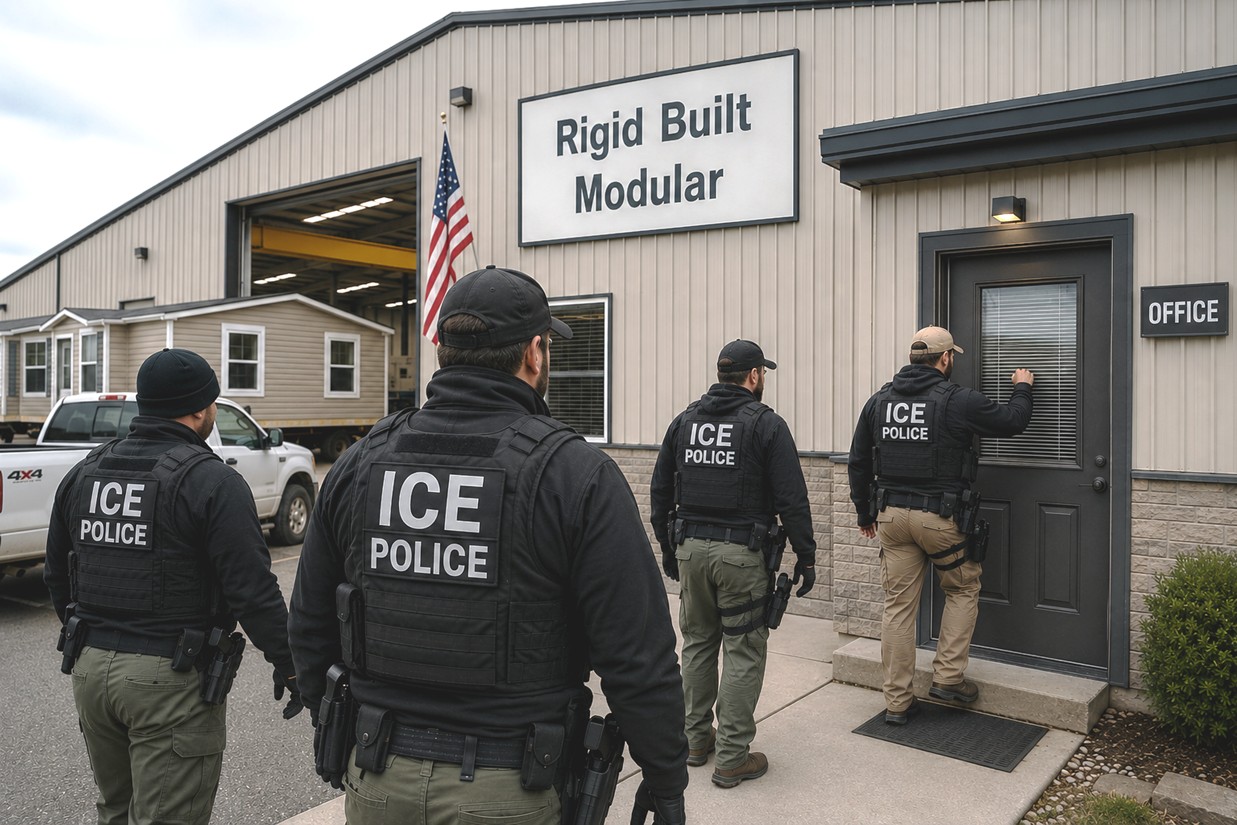
Why Immigration Enforcement Could Become Offsite Construction’s Next Major Disruption
For years, the offsite construction industry has worried about labor shortages. Factory owners have struggled to find welders, electricians, drywall finishers, machine operators, set crew members, truck drivers, and supervisors. Industry conferences have devoted entire sessions to workforce development, while consultants and software providers have offered solutions designed to help factories do more with fewer people.
Yet another labor challenge may be quietly approaching the industry, and many factory owners, developers, and suppliers appear to be assuming it will not affect them. While there have been relatively few publicly reported immigration enforcement actions involving modular factories themselves, there has been increasing enforcement activity at construction job sites throughout the country. If that trend continues, it is difficult to imagine the offsite sector remaining untouched indefinitely.
The belief that modular factories will somehow avoid scrutiny because they manufacture homes indoors rather than build them on jobsites may prove to be a costly assumption.
The Industry Is More Connected Than Most People Realize
When discussing labor shortages, most people immediately think about workers on a production line. However, modular construction is not simply a factory business. It is a network of interconnected companies and trades that must work together seamlessly if projects are to be completed on time and on budget.
Factories build the modules, but transportation companies move them, crane operators set them, utility contractors connect them, finish crews complete them, and suppliers provide the materials that make the entire process possible. When one link in that chain becomes unstable, the consequences ripple outward quickly.
A factory may have enough workers to maintain production, but that advantage disappears if transportation schedules begin slipping or if set crews suddenly become difficult to staff. The problem becomes even more serious when local subcontractors begin to face labor shortages of their own. Before long, production schedules become disconnected from project schedules, and delays begin multiplying throughout the system.
The Hidden Dependence on Labor
The construction industry has relied heavily on immigrant labor for decades. That reality extends far beyond residential job sites and commercial projects. It influences nearly every segment of the construction supply chain, including many businesses that serve the modular and offsite construction industry.
Some factory owners may be surprised to learn how dependent certain vendors, suppliers, trucking companies, and subcontractors are on immigrant workers. A company can have a fully staffed production line and still experience major disruptions if a critical supplier loses personnel or a subcontractor can no longer provide enough workers to meet demand.
The challenge is that these vulnerabilities often remain hidden until a disruption occurs. By the time project managers begin receiving calls about delayed deliveries, reduced crews, or missed schedules, the damage is already underway.
Fear Can Be More Disruptive Than Enforcement
One of the most overlooked aspects of immigration enforcement is its effect on workers’ confidence and availability. In many cases, the fear of enforcement can create disruption long before enforcement actions actually occur.
Workers who hear reports of inspections, audits, or arrests may choose to stay home, seek employment elsewhere, or leave an area entirely. Contractors suddenly find themselves short-handed. Production schedules begin slipping. Vendors struggle to fulfill orders. Project managers spend more time reacting to problems than preventing them.
These disruptions rarely occur all at once. Instead, they emerge gradually through a series of seemingly minor setbacks. A missed delivery here, a reduced crew there, and a delayed inspection somewhere else may not appear significant individually. Combined, however, they can create project delays that destroy budgets and erode profitability.
Vendors May Face the Same Challenges
Many suppliers serving the modular industry assume that workforce issues are primarily a concern for builders and factories. Unfortunately, that assumption may prove incorrect.
Component manufacturers, lumber suppliers, cabinet companies, window manufacturers, transportation firms, and installation contractors all depend on labor. If workforce availability becomes less predictable, these businesses will face many of the same challenges that modular factories face. Longer lead times, increased labor costs, scheduling difficulties, and higher operating expenses could quickly become the new normal.
Those costs rarely remain with the supplier. They eventually work their way through the supply chain and land on the desk of a developer, builder, or factory owner trying to maintain margins on a project that was priced months earlier.
Hoping Is Not a Strategy
One of the most common mistakes businesses make is waiting until a crisis to prepare for it. The construction industry has experienced this pattern repeatedly. Companies ignored labor shortages until they could not hire enough workers. They ignored supply chain vulnerabilities until materials became unavailable. They ignored rising interest rates until projects stopped penciling out.
Now, many organizations appear to be making the same mistake regarding workforce enforcement risks. Their strategy seems to consist largely of hoping the problem never reaches them.
The more prudent approach is to identify vulnerabilities before they become emergencies. Factory owners should understand where labor dependencies exist throughout their supply chains, evaluate critical subcontractors, review contingency plans, and determine which operations would be most vulnerable if labor availability suddenly changed. Those conversations may be uncomfortable, but they are far less painful than dealing with a project that has already fallen behind schedule.
The Storm Doesn’t Need to Hit Your Factory
The greatest risk facing offsite construction may not be an enforcement action inside a modular factory. The greater risk is believing that only direct action matters.
A storm does not need to strike your house to cause damage. Sometimes it only needs to hit the surrounding neighborhood. The same principle applies to labor disruptions. If transportation companies lose workers, if subcontractors struggle to maintain crews, or if suppliers begin missing production targets, modular factories will feel the effects regardless of whether they were directly involved.
Construction remains one of the nation’s largest employers, and every segment of the industry is interconnected. If workforce disruptions spread through construction, modular factories, vendors, transportation companies, developers, and set crews will all face the consequences. The only question is how prepared they will be when that day arrives.
Modcoach Observation

The smartest leaders in offsite construction are not asking whether immigration enforcement could affect their business. They are asking where it will first affect their business. For many, the answer may not be inside the factory walls at all. It may be hidden within a trusted supplier, a transportation company, a subcontractor, or a set crew that has quietly become indispensable to their success. When that link breaks, the disruption can travel through an entire project faster than anyone imagined.