






For years, governments throughout North America have been wrestling with the same problem. Housing prices have risen faster than incomes, rental vacancies have shrunk, young families have struggled to enter the market, and developers have repeatedly warned that regulations, labor shortages, and rising costs make it increasingly difficult to build enough homes.
Most governments respond with familiar solutions. They offer tax incentives, provide grants, release public land, streamline permitting processes, or subsidize buyers. These efforts often help at the margins, but they rarely produce enough housing to make a meaningful dent in the shortage.

Canada has decided to try something very different.
The federal government has created Build Canada Homes, a new agency backed by tens of billions of dollars in financing, with a mission that would have sounded unusual just a few decades ago. Instead of simply encouraging developers to build more homes, the government intends to become an active participant in the development process itself. Its goal is ambitious: help increase housing production to approximately 500,000 homes annually while accelerating affordable housing development across the country.
The announcement has generated considerable discussion within the housing industry, but perhaps nowhere more than among advocates of modular, offsite, and prefabricated construction.
Why Canada Is Taking Such a Dramatic Step
Canada’s housing challenges did not appear overnight.
Population growth has outpaced housing production in many regions for years. Immigration has added demand to already tight markets. Urban centers such as Toronto and Vancouver have seen housing costs increasingly disconnected from average household incomes. At the same time, construction labor shortages have made it difficult for traditional building methods to keep pace with demand.
The result has been a growing realization that simply asking the private sector to build more homes may not be enough.
Many economists and housing experts have argued that the country faces a structural housing shortage that requires production levels far beyond what current systems can deliver. If that assessment is correct, governments can either continue to rely on the same tools they have used for decades or attempt something more aggressive.
Build Canada Homes represents that more aggressive approach.
By providing financing, leveraging public land, and supporting large-scale development efforts, the government hopes to create the conditions necessary for dramatically higher housing output.
Why Offsite Construction Fits the Plan
If Canada hopes to double housing production, traditional construction methods alone are unlikely to get the job done.
Building homes one at a time on individual job sites has limitations. Weather delays projects. Skilled labor remains difficult to find. Productivity gains are often incremental rather than transformational. Even highly successful builders struggle to scale rapidly because every project starts from scratch.

This is where offsite construction becomes particularly attractive.
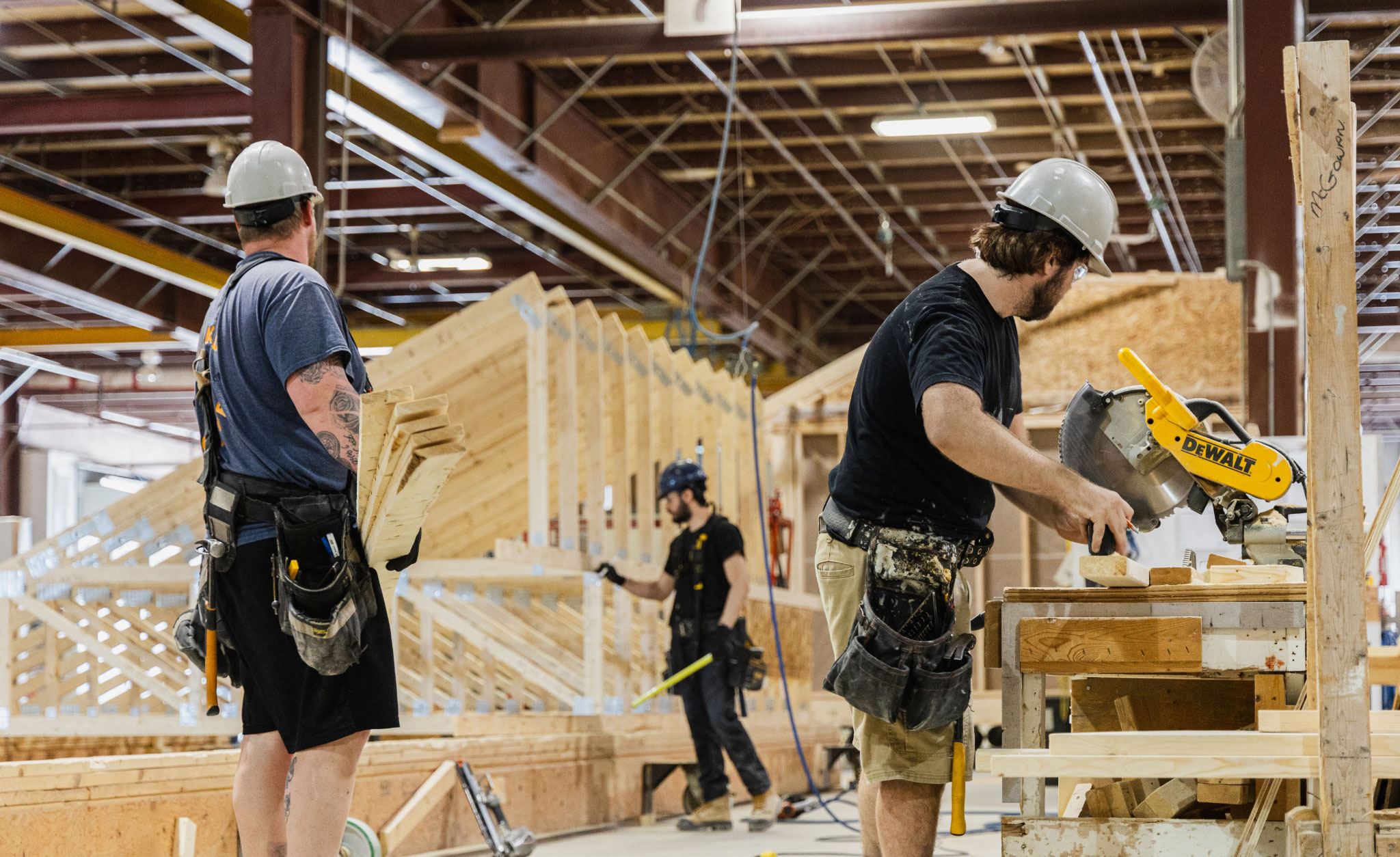
Factories can produce housing components, wall panels, floor systems, and complete volumetric modules in controlled environments where weather has little impact on production schedules. Material waste can be reduced, quality control improved, and construction timelines shortened.
Perhaps most importantly, factories enable repeatability.
When a factory produces hundreds or thousands of similar housing units, processes become refined, workers become more efficient, and production capacity becomes more predictable. These are the same principles that transformed industries such as automotive manufacturing and consumer products decades ago.
For a government seeking to rapidly increase housing production, those advantages are difficult to ignore.
The Demand Problem That Has Held Factories Back
One of the most overlooked challenges facing modular and offsite construction has never been technology. It has been in demand.
Many factories can significantly increase production. What they often lack is confidence that enough projects will exist two, three, or five years from now to justify major investments in equipment, automation, workforce development, and facility expansion.
Developers cancel projects. Financing disappears. Interest rates rise. Markets shift.
Factory owners know that adding production capacity is easy compared to keeping it busy.
Canada’s approach could address that concern directly. If government-backed housing programs create a reliable pipeline of projects, manufacturers may finally have the confidence to invest in larger facilities, more automation, and expanded production lines.
For the offsite industry, that may be one of the most significant aspects of the entire initiative.
The Roadblocks Nobody Should Ignore
As promising as the plan sounds, several significant challenges remain.
The first is infrastructure.
Building homes is only part of the equation. Communities also need roads, water systems, sewer capacity, electrical service, schools, healthcare facilities, and transportation networks. Housing production can move quickly, but infrastructure improvements often move at a much slower pace.
The second challenge is regulation.
Many governments say they support innovation and housing affordability. Yet local planning departments, zoning boards, code officials, and permitting agencies frequently create delays that add months or even years to project schedules. If those barriers remain in place, even the most efficient factory cannot solve the problem.
A third challenge involves labor.
While factories generally require fewer workers than traditional site-built construction, they still need skilled employees, transportation providers, crane operators, set crews, finish crews, inspectors, and project managers. Expanding housing production at scale will require workforce development that keeps pace with factory expansion.
Finally, there is the challenge of political consistency.
Housing initiatives often span multiple election cycles. What begins under one administration may be altered, delayed, or abandoned by the next. The housing industry has seen many ambitious plans announced over the years. The true test will be whether Canada can maintain a long-term commitment regardless of political changes.
A Housing Experiment the World Will Be Watching
Whether Build Canada Homes ultimately succeeds or falls short, it has already accomplished something important.
It has shifted the conversation from simply discussing housing shortages to discussing housing production.
For decades, governments have largely stepped back from direct involvement in housing development. Canada is now testing whether a more active role can accelerate construction and improve affordability.
The answer may have implications far beyond Canada’s borders.
Modcoach Observation

For years, I’ve heard factory owners say they could build far more homes if somebody would simply provide a consistent stream of projects. I’ve also heard developers complain that financing, land availability, permitting delays, and infrastructure costs make it nearly impossible to build housing at the scale communities need.
Canada is attempting to tackle all of those issues at once. The interesting question isn’t whether modular and offsite construction can produce the homes. The industry has already proven it can. The real question is whether government, developers, local agencies, utilities, manufacturers, and contractors can work together long enough to turn a bold housing vision into actual neighborhoods filled with people. If they can, Canada may become the case study that housing experts around the world reference for decades to come.