




Picture a modular factory owner looking over a set of apartment plans. Upstairs are three floors of kitchens, bathrooms, and bedrooms that look enough alike to keep his production manager happy. Downstairs, right where he’d like a bearing wall, the architect has drawn a wide-open community room. Nobody wants a post in the middle of the room. Especially the fellow who already promised the developer it could host a wedding reception.
Years ago, that set of plans might have gone back across the desk with a polite request to move a few walls. Today, there’s a better conversation to have. Could a concrete podium carry the apartments over that open room? Could the factory build the upper floors using the wood framing its people already know? And could somebody put a price on that arrangement before the sales guy books the wedding?
That’s a hybrid building, and it raises a pretty good business question for offsite construction. How much more work could a factory take on if it stopped expecting its favorite material to solve every problem on the drawings?
There’s a Good Reason That Factory Builds in Wood
Ask a plant owner why he builds in wood, and he might tell you it’s what he’s always done. Give him another minute. His purchasing manager knows which supplier will come through on a short week. His line supervisor knows who can frame a tricky opening. His estimator can look at a custom ranch and spot the detail that will eat up Friday afternoon. A lot of money is tied up in “what we’ve always done,” and most of it took years to earn.
The trouble starts when the factory tries to stretch that experience across every job that comes through the door. A school corridor, an apartment over a parking garage, and a two-bedroom ranch on a rural lot have very little in common once you get past the fact that people prefer all three to be dry inside.
Take that apartment project. The community room presents one structural problem. The thirty kitchens above it present a production opportunity. If a concrete contractor can deliver the base and the modular factory can deliver those apartments, the owner has a shot at a project he might otherwise pass up. He can even leave his lumber racks right where they are.
You Can Buy the Part You Don’t Make
This is where the phrase “factory of the future” can get expensive quickly. Mention hybrid construction at a management meeting, and somebody will start measuring the floor for a steel fabrication cell. Before anybody calls the equipment dealer, I’d like to hear from purchasing. Is there already a shop within trucking distance that makes exactly what we need?
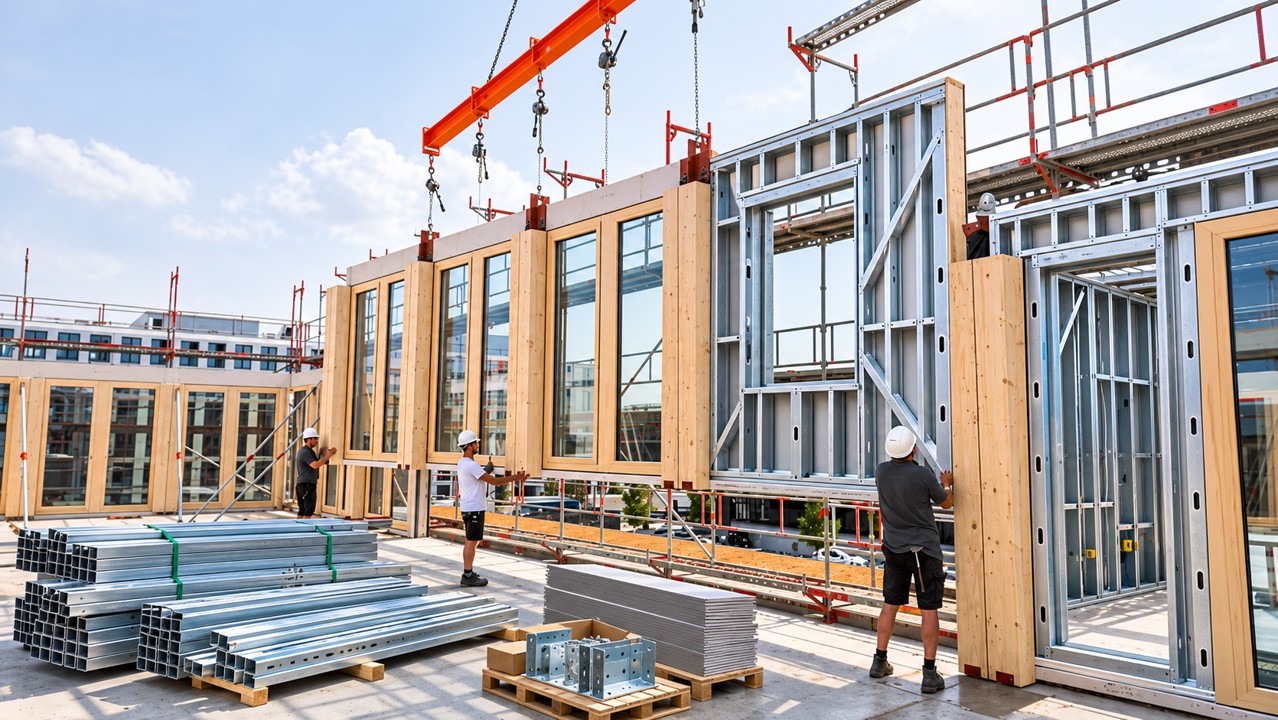
An engineered cross-laminated timber (CLT) panel might give a school the exposed wood ceiling the architect wants and let the crew set a finished surface in one lift. A light-gauge steel supplier might deliver a run of precisely framed wall panels. A specialist might build and test a mechanical, electrical and plumbing assembly on a bench while the factory frames the modules that will receive it. Each is a different decision. A factory can use one of them without signing up for the other two.
And there’s an important question for that last supplier. When the assembly is in place and the wall is closed, can a plumber still get a wrench on the connection? I suspect a five-minute visit from the service guy while the prototype is on the bench could save everybody an interesting afternoon in Apartment 304.
Who Owns the Inch?
Back at our apartment project, the concrete crew works from one set of drawings and the factory works from another. Both teams can do beautiful work. Then the first module arrives, and somebody discovers the anchor is an inch away from where the factory expected it. The crane is on the clock, the next truck is coming up the street, and two foremen are holding drawings with different revision dates.
That inch belongs to somebody. A hybrid project earns its keep when the team decides who owns it while there’s still time to act. Who establishes the reference point both crews measure from? Who checks the as-built conditions? Whose signature releases the trucks? A shared digital model can show exactly where an anchor belongs. Somebody still has to walk out there with a tape.
The same goes for approvals. If the wall, floor, and connection come from different companies, somebody has to show the reviewer how the completed assembly meets the project’s requirements, including what happens to the fire protection where the trades meet. An early conversation with the people reviewing the building gives the engineer a chance to address their questions while the detail is still on a screen. Once twenty modules have drywall on both sides, the conversation tends to cost more.
Follow the Money All the Way to the Site
Suppose the estimator gets two prices for a mechanical assembly. The factory can build it for less than the specialist wants to charge. Easy decision? Maybe. I’d ask the production manager where he plans to put it together and what normally happens in that space. If his best plumber spends Thursday building an assembly while two finished modules wait for testing, the cheaper quote has some explaining to do.
It works the other way, too. The supplier’s assembly may go in quickly, but a dedicated truck, extra lifting equipment, and half a day opening up a finished wall can wipe out the labor savings. On the second order, the first question I’d ask the superintendent is how long it actually took his crew to hook up the first one. His answer belongs in the next estimate.
Gary’s Observation

I have a soft spot for the modular mutts. There’s something wonderfully practical about a wood-framed apartment sitting on a concrete base with a steel assembly tucked inside it, especially if the people who built it can explain what each choice did for the job.
If I owned that factory, I’d want to be standing beside the superintendent when the first apartment lands over the community room. Did it fit? Could the crew reach the connections? What did they have to do that nobody carried in the bid? Before I priced the next building, I’d buy that fellow lunch. He’s already seen the part of my estimate I got wrong.