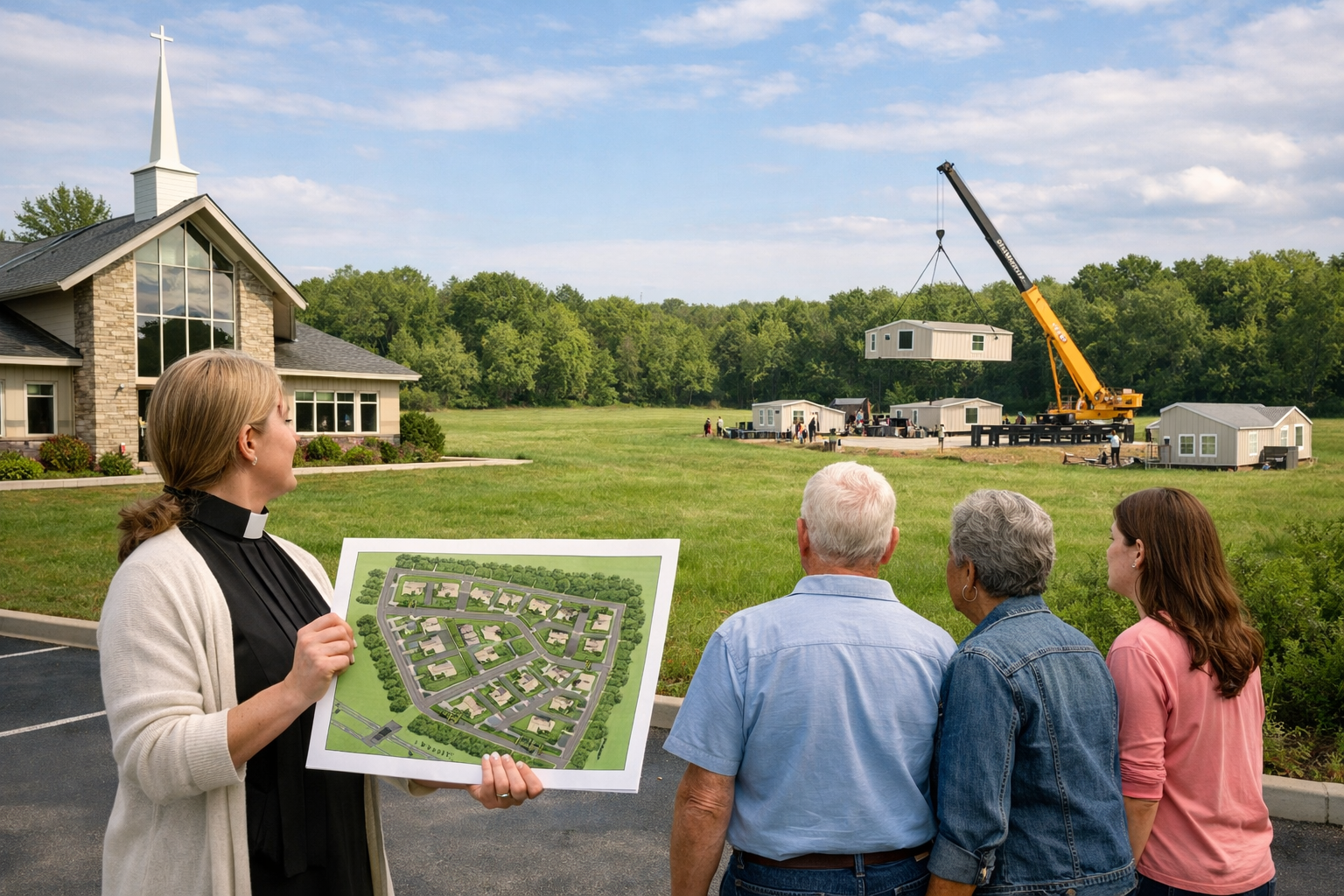
Across the country, a quiet but powerful idea is gaining traction—churches, synagogues, and other faith-based organizations are stepping forward to turn their underused land into housing. The movement, now known as “Yes in God’s Backyard” (YIGBY), is rooted in something simple: if you already own the land, why not use it to serve the community?
And the need couldn’t be clearer. The U.S. is facing a shortage of more than four million homes, pushing affordability further out of reach for millions of families.
Churches are uniquely positioned to help. They already own land—often in established neighborhoods—and they understand the needs of the people around them. But while the mission is clear, the execution is anything but simple.
That’s where the disconnect begins.
The Hidden Opportunity Sitting in Plain Sight
Faith-based properties are everywhere, and many of them are underutilized. Parking lots that fill once a week. Green space that serves no purpose. Buildings with empty classrooms or shrinking congregations.
In Maryland alone, tens of thousands of acres of faith-owned land could potentially support tens of thousands of housing units if even modest density were applied.
Nationally, the numbers are staggering. Millions of acres of land sit in the hands of religious institutions—land that could become housing almost immediately if barriers were removed.
But here’s the problem no one wants to talk about: just because churches own the land doesn’t mean they can build on it easily.
The Reality Check: Churches Aren’t Developers
Most congregations are land-rich and cash-poor. They don’t have development teams. They don’t understand financing structures. They certainly don’t have the time or experience to manage a multi-year construction project.
Even when zoning barriers are removed—and that’s a battle in itself—the process of building housing remains expensive, complicated, and slow.
Developers often want larger projects. Financing is complex. Timelines stretch into years. And every delay increases costs and risk.
So while YIGBY is full of potential, it’s also full of friction.
Why Modular Housing Fits YIGBY Like a Glove
This is where modular housing doesn’t just help—it changes everything.
Think about what YIGBY projects need: speed, cost control, predictability, and minimal disruption to existing communities.
That’s exactly what offsite construction delivers.
Instead of treating each church project like a one-off development, modular factories can standardize designs, control production costs, and compress timelines dramatically. A project that might take years onsite can be delivered in months when built in a factory and assembled on church-owned land.
More importantly, modular construction reduces the complexity that churches struggle with. Instead of managing dozens of trades over an extended period, they’re coordinating a system—one that’s already engineered, tested, and repeatable.
Small Parcels, Big Potential
One of the biggest challenges developers face with YIGBY is scale. Many church properties aren’t large enough to attract traditional developers looking for 100-unit projects.
But modular thrives in exactly this environment.
Small infill projects. Duplexes, triplexes, cottage clusters, and low-rise multifamily. These are the kinds of developments that can fit naturally into existing neighborhoods without triggering community resistance.
And they align perfectly with the mission of faith-based organizations—serving people without overwhelming the community fabric.
Speed Matters More Than Anyone Admits
Here’s a truth the industry doesn’t like to say out loud: housing delayed is housing denied.
Every extra month in permitting, financing, and construction adds cost and reduces affordability.
Modular construction attacks that timeline head-on. While the foundation is being prepared onsite, the units are already being built in a controlled environment. Weather delays disappear. Labor inefficiencies shrink. Quality improves.
For YIGBY projects—where urgency is tied directly to community need—that speed isn’t a luxury. It’s the difference between an idea and a solution.
A New Partnership Model Waiting to Happen
The real opportunity isn’t just modular housing. It’s the partnership between modular factories and faith-based organizations.
Churches bring the land.
Factories bring the product.
Developers bring the financing and structure.
Together, they create a repeatable model that could be replicated across thousands of properties nationwide.
Instead of reinventing the wheel for every project, this becomes a system—a scalable solution to a problem that desperately needs one.
What’s Holding It Back
If the fit is so perfect, why isn’t it happening everywhere?
Zoning is still a barrier in many areas, although legislation is beginning to change that.
Financing remains complex, especially for smaller projects.
And perhaps most importantly, there’s still a lack of awareness. Many faith leaders don’t know modular is even an option. Many modular factories haven’t recognized YIGBY as a market worth pursuing.
That gap—between opportunity and awareness—is where the real problem lies.
Modcoach Observation
This isn’t one of those “someday” opportunities. It’s sitting there right now, waiting for someone to connect the dots.
If you’re a modular factory owner, ask yourself one question: how many churches are within 50 miles of your plant that have unused land and no idea you exist?
If you’re a developer, how many smaller parcels have you walked away from because they didn’t fit your traditional model?
And if you’re a faith leader, how long will that empty piece of land sit there while your community struggles to find housing?
The YIGBY movement has the land, the mission, and the momentum.
Modular housing has the speed, the system, and the scalability.
Put the two together, and you don’t just build homes—you create a repeatable solution hiding in plain sight.