

Old myths still quietly sabotage modular’s real-world performance and acceptance
I’ve been around this industry long enough to know that most resistance to modular construction doesn’t come from bad experiences—it comes from bad information.
The kind that gets repeated at job sites, whispered between builders, and shared with confidence by people who have never actually completed a modular project.
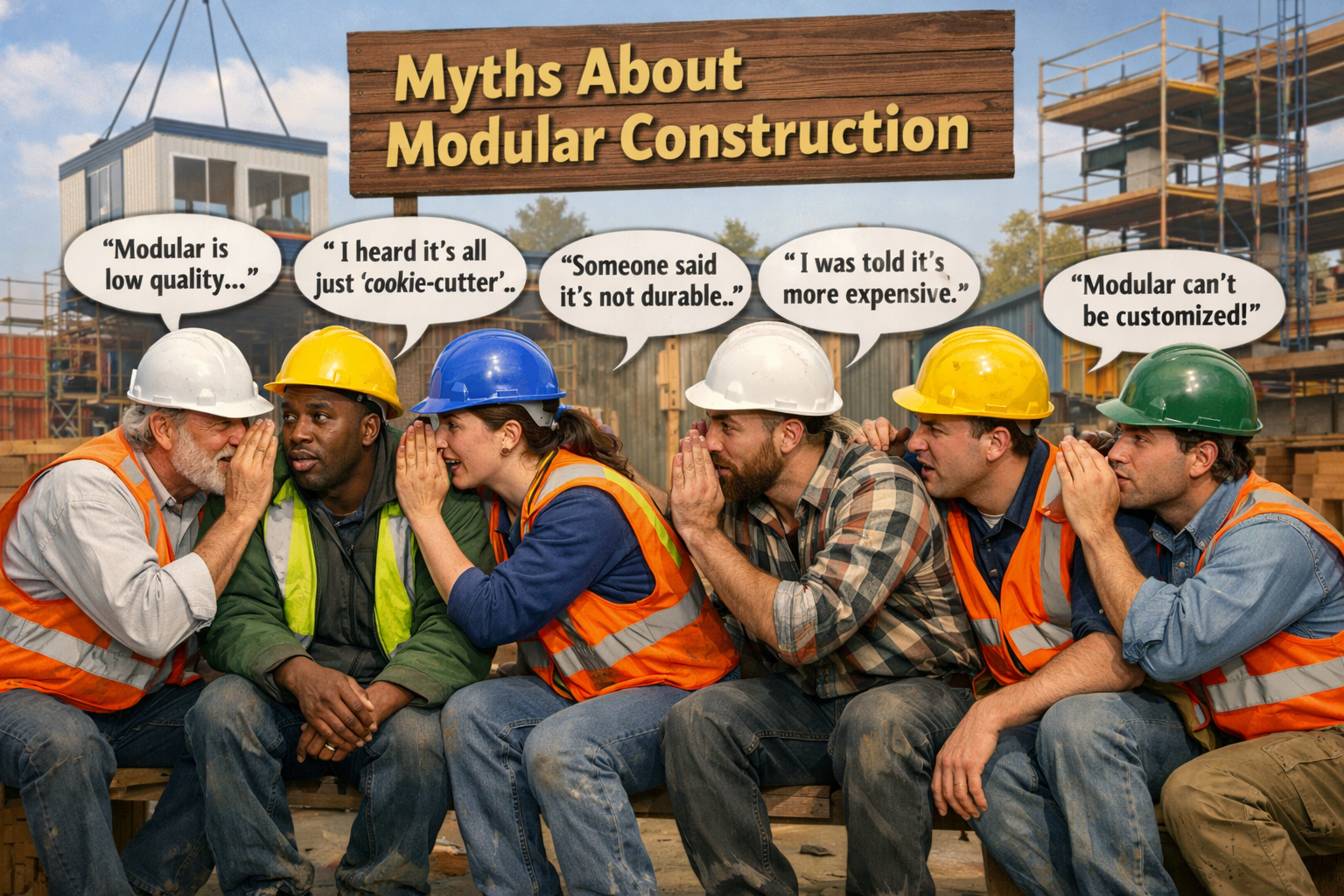
What’s interesting isn’t that these myths exist. It’s that they refuse to die, even as modular continues to outperform site-built construction in areas that truly matter—quality, speed, and predictability.
Let’s take a walk through the seven biggest myths still being passed around like jobsite folklore—and what the truth really looks like when the dust settles.
Myth #1: “Modular homes are lower quality than site-built homes”
This one always makes me smile.
Modular homes are built in a controlled factory environment, where materials are protected from weather, inspections happen at multiple stages, and processes are repeatable. Compare that to a site-built home framed in the rain, baked in the sun, and inspected after the fact.
The truth:
Modular homes often exceed site-built quality because they are built under stricter conditions, with more consistent oversight, and fewer environmental variables. Many are built to meet or exceed the same—or higher—codes.
Myth #2: “They all look like boxes”
That may have been true decades ago, but it hasn’t been true for a long time.
Today’s modular homes include complex rooflines, open floor plans, multi-story designs, and high-end architectural features. The “box” stereotype sticks around because people remember what modular used to be, not what it is today.
The truth:
If a home looks like a box, it’s because someone designed it that way—not because modular couldn’t do something better.
Myth #3: “You can’t customize a modular home”
This one usually comes from builders who’ve never actually worked with a modular factory.

Customization exists—but it’s structured. You’re working within a system, not starting from scratch on every single decision.
The truth:
Modular offers a different kind of customization—one that balances flexibility with efficiency. You can customize layouts, finishes, elevations, and features, but within a framework that keeps costs and timelines under control.
Myth #4: “Modular homes don’t hold their value”
This myth has done more damage than almost any other.
Lenders, appraisers, and even real estate agents sometimes repeat it, even though data continues to prove otherwise.
The truth:
A properly designed and installed modular home appreciates at rates comparable to site-built homes—because it is a site-built home once it’s set. Same foundation, same materials, same neighborhoods.
The only difference is where it was assembled.
Myth #5: “Transportation damages the home”
Yes, modules are transported. No, they don’t arrive falling apart.
What most people don’t understand is that modular homes are engineered to be stronger than site-built homes because they must withstand transportation and crane setting.
The truth:
Modular structures are often overbuilt compared to site-built homes. Additional fastening, bracing, and structural reinforcement are required—making them, in many cases, more durable.
Myth #6: “Modular is always cheaper”
This one goes the other way—and it’s just as misleading.
There was a time when modular had a clear cost advantage. Today, with rising material costs, labor shifts, transportation expenses, and regulatory requirements, that gap has narrowed significantly.
The truth:
Modular is not always cheaper—but it is often more predictable. And in today’s world, predictable costs and timelines can be more valuable than chasing the lowest number on paper.
Myth #7: “It’s faster, so corners must be cut”
Speed makes people suspicious.
If something is built faster, the assumption is that something must have been skipped.
That assumption doesn’t hold up.
The truth:
Modular is faster because work happens simultaneously. Site work and home construction occur at the same time instead of sequentially. It’s not about cutting corners—it’s about eliminating downtime.
So Why Do These Myths Still Exist?
Because too many people in our industry are still learning about modular from someone who also never really learned it properly.
It’s a chain of secondhand opinions.
And until builders, developers, and buyers take the time to understand how modular actually works—from design through set day—these myths will keep circulating like they’re facts.
Modcoach Observation

If you’re a builder or developer still repeating any of these myths, you’re not just misinformed—you may be quietly costing yourself opportunities.
There’s a growing number of projects—additions, ADUs, multi-family, even light commercial—that are better suited for modular than conventional construction. But they’re only going to the people who understand how to use it properly.
The others?
They’re still sitting in lawn chairs, watching the industry move forward without them.
And if that stings a little, good.
Because the next step isn’t defending what you think you know—it’s picking up the phone and finding out what you don’t.