





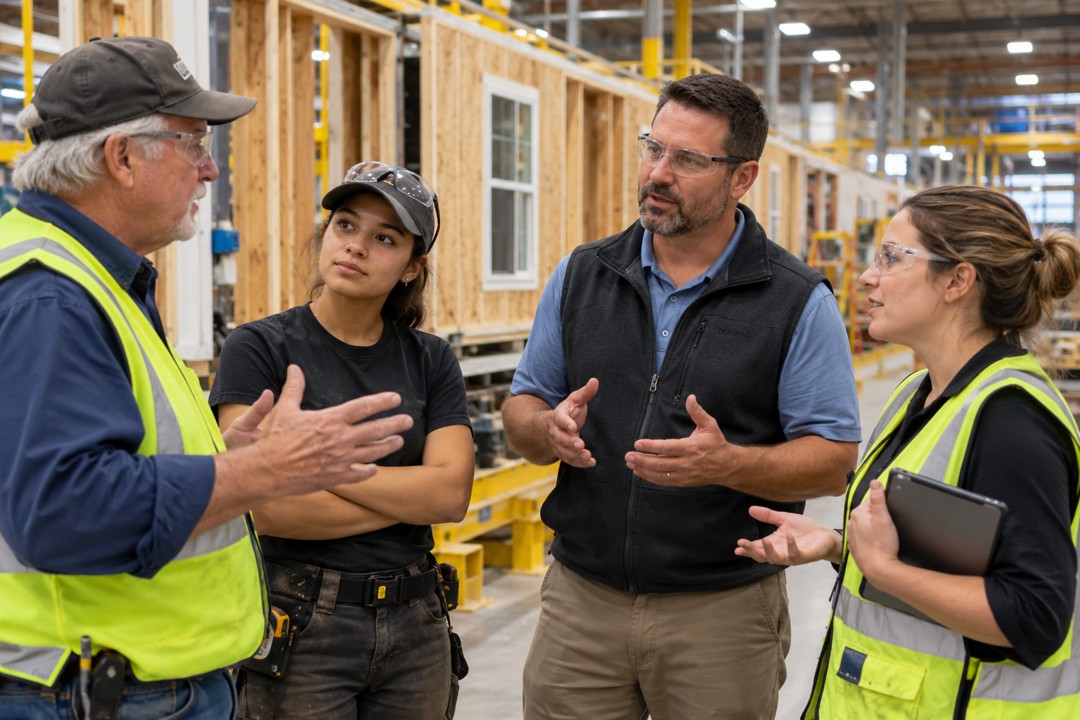
As Baby Boomers leave factory careers, their successors inherit more than positions. They inherit the responsibility to preserve hard-earned knowledge while changing how the business operates.
When a longtime factory manager walks out after the final shift, the company can collect the keys, reassign the office, and change the name on the production meeting agenda. Replacing everything that person knows is much harder. Some of the most valuable information may never have appeared in a manual, spreadsheet, or employee training session.
It might be an understanding of which wall assembly needs extra attention before it moves down the line, which supplier can solve an unusual material problem, or which apparently minor schedule change will create trouble three stations later. Those lessons accumulate over years of building homes, correcting mistakes, and managing people under pressure.
As Baby Boomers leave offsite factory positions, the transition raises a question that reaches beyond retirement: What kind of organization are they leaving behind, and how different are the people now responsible for running it?
The answer cannot be reduced to younger employees using newer technology. The deeper change concerns where authority comes from, how knowledge moves through a company, and what workers expect from their supervisors.
The Numbers Behind the Handoff
No verified industry-wide breakdown exists of offsite factory employees by generation and department. National occupational data offers a useful comparison, however, when its limitations remain visible.
The following figures are approximate generational estimates derived from 2025 Bureau of Labor Statistics age data. They are not published BLS generational percentages or results from a modular factory survey.
Generation Production occupations Industrial production managers Manufacturing and wholesale sales representatives Gen Z — born 1997 onward, working age 20% 9% 15% Millennials — born 1981–1996 36% 36% 38% Gen X — born 1965–1980 31% 42% 33% Baby Boomers and older — born before 1965 13% 13% 14% Total 100% 100% 100%
Source: U.S. Bureau of Labor Statistics, “Employed people by detailed occupation and age,” Table 11b: https://www.bls.gov/cps/cpsaat11b.htm.
The estimates place Gen X and Millennials together at roughly 78% of industrial production managers. They also suggest that Millennials make up the largest share of these estimated groups in production- and manufacturing-related sales.
The implication for offsite companies is a question worth examining locally: Has the leadership handoff already occurred on the organization chart while essential knowledge still rests with employees approaching retirement?
The Factory They Entered and the Factory They Leave
Baby Boomers did not all begin their careers in the same kind of factory. Their experiences span different decades, products, ownership structures, and levels of mechanization. A small family-owned modular business and a large manufactured housing operation could provide very different introductions to factory life.
Nevertheless, consider the contrast between two ways of organizing the work. In one, much of the operating knowledge travels through direct instruction: watch an experienced employee, learn the sequence, and ask the supervisor when something changes. In the other, drawings, production status, purchasing information, and quality records are expected to be accessible across departments.

These approaches can coexist in the same building. A factory may have sophisticated design software while still depending on one employee to explain why a particular detail never works as drawn. It may track production electronically while relying on a veteran supervisor to recognize that the reported progress is misleading.
The incoming manager’s task is to connect those sources of knowledge. Installing a system does not automatically capture experience, and retaining experienced people does not automatically make their knowledge available to others.
Experience Is Changing Hands—and Changing Form
A retiring supervisor may recognize a developing problem before anyone can explain it numerically. A successor may want evidence showing how often the problem occurs, what it costs, and whether a proposed correction actually works.
Both approaches have value. Trouble begins when either is treated as sufficient by itself.
Consider an illustrative situation: an experienced production leader knows that a particular wall configuration regularly delays the next station. A younger manager asks for the delays to be recorded. The useful outcome is a shared investigation that connects the supervisor’s judgment with records the engineering and scheduling teams can act upon.
That process turns an individual’s experience into an organizational capability. It also gives the experienced employee a role in improving the system rather than merely explaining it repeatedly to each new hire.
For a company approaching several retirements, this distinction matters. Filling vacancies preserves headcount. Transferring judgment preserves the ability to operate.
The Middle Generations Are Already Responsible
National estimates suggest the leadership story is largely about Gen X and Millennials carrying management responsibility today. Describing them simply as the next generation can obscure the decisions they already make.
Their responsibilities include deciding which established practices deserve protection, which need revision, and which survive mainly because nobody has revisited them. That requires more than enthusiasm for change. A process that looks inefficient from an office may be compensating for a recurring problem elsewhere in the factory.
Equally, a familiar workaround may conceal a defect that should have been corrected years ago. A supervisor who repeatedly rescues the schedule can become indispensable while the cause of the disruption remains untouched.
Managers of any age face that tension. The question is whether their experience helps them prevent the next emergency or merely makes them faster at handling it.
Production Workers Need a Way to Learn
With Gen Z representing an estimated one-fifth of the broad production category, factories have reason to examine how unfamiliar workers become capable employees. The issue is practical: What does a new person need to know, who teaches it, and how does the company determine whether the training worked?
“Watch someone experienced” can be part of a strong training approach. It becomes unreliable when the experienced worker has no time to explain, different trainers give conflicting instructions, or an employee is expected to infer a quality standard that has never been made explicit.
Clear instructions, demonstrations, feedback, and explanations of downstream consequences can help employees of all ages. A new worker who understands why a dimension matters is better positioned to recognize a problem than one who has only been told to follow a step.
Questions about established practices can be equally useful when handled constructively. A manager can explain the reason for a requirement while remaining willing to investigate whether the method could improve.
Sales Is Part of the Same Transition
The generational handoff extends into sales, where product knowledge and customer relationships can depend on individuals as much as production expertise.
A longtime representative may understand which changes a builder will request, where a preliminary specification is incomplete, or when a delivery expectation is unrealistic. Reassigning that representative’s accounts does not automatically transfer those insights.
A successor needs more than contact information. The company needs a record of commitments, recurring concerns, product decisions, and the operational reasons behind them. Otherwise, the customer may discover the knowledge gap before management does.
Sales and production also need a shared understanding of what the factory can deliver. A promised customization affects engineering, purchasing, labor, and scheduling regardless of the salesperson’s age. Better information across those functions gives the next generation a stronger foundation for making commitments.
A Handoff That Preserves the Ability to Improve
Generational labels help frame the transition, but they do not explain an individual manager’s behavior. A Baby Boomer may champion automation. A Millennial may prefer a strict chain of command. A Gen X supervisor may be an exceptional teacher, while a Gen Z employee may thrive under a highly structured process.
Career experience, training, ownership expectations, and factory conditions all influence how people work. The most productive conversation therefore concerns what the business needs to retain and what its new leaders must be equipped to change.
A strong handoff gives departing employees time to explain difficult decisions, demonstrate unusual tasks, and help successors recognize situations that routine instructions cannot fully cover. It also gives successors the authority to improve those instructions as conditions change.
The factory keys may pass from one generation to another in a single afternoon. The more consequential transfer takes longer: turning decades of individual experience into knowledge that remains useful after its original owners have gone home.