



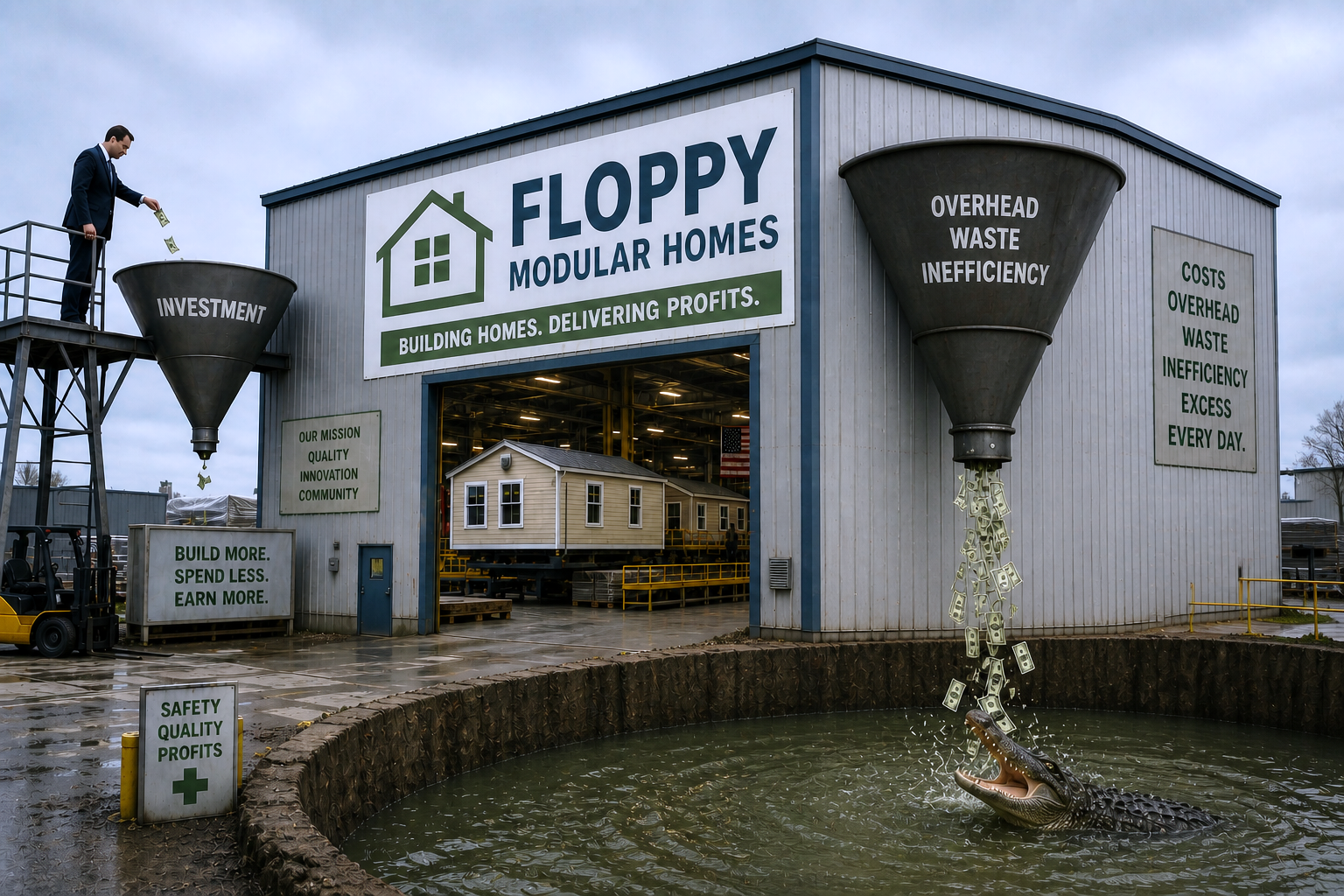
For many modular factory owners, the excitement of opening a modern facility—complete with advanced machinery, organized production lines, and a skilled workforce—fades faster than expected. What replaces it is a quieter, far more troubling reality: the numbers don’t work.
Month after month, the factory isn’t just underperforming—it’s losing money. This isn’t an isolated situation or a run of bad luck. It’s a pattern I’ve seen repeat itself across the industry, regardless of location, size, or level of investment.
Modular construction still gets promoted as faster, more efficient, and more profitable than site-built construction. And in many cases, it can be. But profitability isn’t automatic. It has to be engineered just as carefully as the homes coming off the line.
Let’s take a closer look at where things go wrong—and how to fix them before the damage becomes irreversible.
Pricing That Doesn’t Reflect Reality
Most financial problems in modular factories begin long before production starts, and they often start with pricing decisions made under pressure. In the rush to secure contracts and keep the production line moving, factories frequently underbid projects, convincing themselves they’ll make it up through volume or operational efficiencies.
That strategy almost never works out the way it was planned. Material costs fluctuate, labor hours exceed estimates, and minor inefficiencies begin to stack up. What looked like a thin but manageable margin quickly turns into a loss, and by the time the factory realizes it, the project is already too far along to recover.
The deeper issue is that many factories are still relying on outdated costing models or static spreadsheets that don’t reflect current conditions. Without real-time visibility into costs, pricing becomes guesswork. And in this business, guessing is expensive.
Factories that regain control of their pricing do so by tightening their feedback loops. They track costs in real time, review pricing models regularly, and adjust quickly when conditions change. It’s not glamorous work, but it’s essential.
Production Lines That Hide Inefficiencies
At first glance, most modular factories appear busy and productive. There’s constant movement, materials are flowing, and modules are progressing through the line. But activity can be misleading.
Behind that movement are often small inefficiencies that compound over time. A delay at one station creates a backup at the next. Rework gets pushed downstream. Workers spend more time waiting or correcting mistakes than actually building.
These issues don’t always stand out in a walkthrough, but they show up clearly in labor costs and missed schedules. A 10- or 15-minute delay per module may not seem significant in isolation, but over the course of a year, it can translate into hundreds of lost labor hours and significant margin erosion.
The solution begins with measurement. Time studies, workflow analysis, and a willingness to question long-standing processes are necessary to uncover the real problems. Once identified, improvements in sequencing, staffing, and, in some cases, automation can restore flow and reduce waste.
Overhead That Outpaces Production
Many modular factories are built with growth in mind. Large facilities, significant equipment investments, and expanded payrolls are all justified by projected production volumes that haven’t yet materialized.
When those volumes fall short, overhead quickly becomes a burden rather than an asset. Fixed costs remain high while revenue lags behind, and the gap between the two widens with each passing month.
The uncomfortable reality is that overhead must align with actual production, not projected capacity. If a factory’s break-even point requires producing 20 modules per month but it’s only delivering 12, the math simply doesn’t work.
At that point, leadership faces a difficult but necessary decision. Either reduce costs to match current demand or find a way to increase throughput quickly and sustainably. Ignoring the mismatch only accelerates the financial decline.
Overpromising and Underdelivering
Sales and production don’t always speak the same language, and when that disconnect exists, it creates problems that ripple throughout the organization. In an effort to secure large contracts, factories sometimes commit to aggressive timelines that their production systems aren’t equipped to meet.
Those commitments may win the job, but they often create delays, strain internal operations, and damage relationships with developers. Late deliveries can lead to financial penalties, lost trust, and a reputation that’s difficult to repair.
Factories that perform well over time are disciplined in how they set expectations. They understand their true capacity and communicate it clearly, even when it means pushing back on a potential client. Consistency and reliability ultimately prove more valuable than overpromising and falling short.
A Sales Pipeline That Isn’t Sustainable
Even the most efficient factory can’t survive without a steady flow of work. Unfortunately, many modular operations rely too heavily on a small number of clients, a single product type, or a narrow market segment.
When demand shifts or a key client pulls back, the pipeline dries up quickly, leaving the factory underutilized and financially exposed. Idle capacity is expensive, and restarting momentum after a slowdown is never easy.
A more resilient approach involves diversifying both the customer base and the product mix. Expanding into areas such as multifamily housing, ADUs, or light commercial projects can help stabilize demand. At the same time, investing in dedicated business development ensures that new opportunities are consistently being pursued rather than passively awaited.
Leadership Blind Spots
Leadership plays a central role in every successful modular factory, but it can also be a source of hidden challenges. Many owners and managers come from either a construction background or a manufacturing background, but not both.
That imbalance can lead to gaps in understanding. A factory run too much like a traditional construction company may struggle with efficiency and standardization, while one run purely as a manufacturing operation may overlook the complexities of site work and customer expectations.
Bridging that gap requires continuous learning and a willingness to seek outside perspectives. Leaders who invest in expanding their knowledge—and who bring in advisors or team members with complementary experience—are better equipped to make informed decisions and avoid costly mistakes.
Cash Flow: The Issue That Brings Everything to a Halt
Profitability on paper doesn’t guarantee survival. Cash flow timing often determines whether a factory can continue operating, regardless of how strong its backlog appears.
Expenses such as payroll, materials, and overhead occur continuously, while revenue is often tied to project milestones or final delivery. This mismatch can create periods where cash outflows exceed inflows, putting significant strain on the business.
Managing cash flow effectively requires careful planning and negotiation. Structuring payment schedules to include upfront deposits, aligning billing with production progress, and maintaining a financial cushion are all critical steps in avoiding a cash crisis.
Modcoach Observation

When a modular factory consistently loses money, it’s rarely due to a single issue. More often, it’s the result of multiple small problems that, when combined, create a system that no longer works.
The encouraging part is that these problems are identifiable and, in most cases, fixable. But they require honest assessment, disciplined execution, and a willingness to make changes that may be uncomfortable in the short term.
Factories that take those steps give themselves a chance to succeed. Those that don’t tend to follow a much shorter path.
After more than a few decades in this business, I’ve come to a conclusion that doesn’t always sit well with factory owners and upper management. Modular construction itself isn’t the problem. The concept works. The demand is there. The technology continues to improve.
What fails, more often than not, is the execution.
Factories don’t go out of business because modular doesn’t make sense. They go out of business because decisions—often small ones made day after day—aren’t aligned with reality. Pricing that ignores actual costs, production systems that aren’t truly efficient, overhead built on hope instead of orders, and leadership teams that assume they’ve already figured it all out all contribute to the outcome.
There’s also a tendency in this industry, like many others, to look outward for explanations. It’s the economy. It’s regulations. It’s material prices. It’s labor shortages. And while all of those factors play a role, they’re rarely the primary reason a factory fails.
The real turning point comes when leadership stops looking outside the building for answers and starts looking inside. That’s where the problems are created, and it’s also where they can be solved.
The factories that survive—and eventually thrive—are the ones that are willing to confront those realities head-on, make adjustments quickly, and stay disciplined even when things start going well again.
Because in this business, success isn’t something you achieve once.
It’s something you have to protect every single day.