

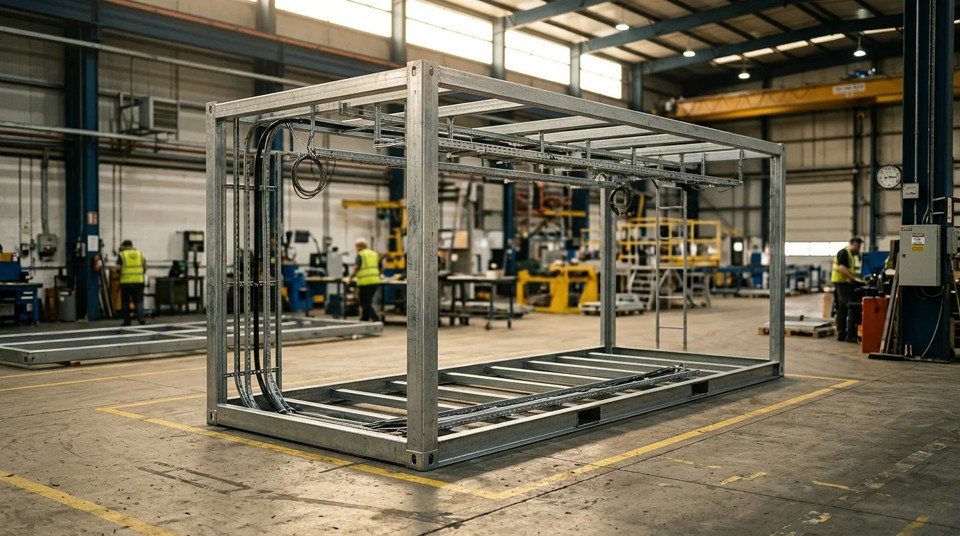
Every few weeks, the construction industry produces another announcement involving artificial intelligence, modular manufacturing, and a potentially enormous order. The usual ingredients are all there: an advanced product, a big market, an impressive rendering, and language suggesting production could eventually become massive. By the time the story reaches social media, a prototype agreement has somehow transformed into a factory running three shifts and producing hundreds of units.
That is not what happened here, although what actually happened is still interesting.
Rhaelm Holdings, a UK-based developer of sovereign AI infrastructure, has agreed to pay Workhorse Group $10 million to build a full-scale TerraPod manufacturing-specification unit at Workhorse’s Union City, Indiana, facility. The money will be paid in three installments under a binding development agreement.
The frequently mentioned possibility of Workhorse producing 150 TerraPod systems is not a firm order. It appears in a nonbinding letter of intent and depends on several things happening first, including completion and acceptance of the prototype, execution of a definitive supply agreement, and additional internal approvals.
One unit is funded. The other 150 are still a possibility. That distinction matters more than the size of the number appearing in the headline.
A Former Vehicle Factory Gets a New Assignment
Workhorse is best known for electric commercial vehicles. Its Union City operation already has manufacturing space, equipment, skilled employees, and experience integrating complex electrical and mechanical systems.
Instead of building a brand-new modular data-center factory, Rhaelm is testing whether an existing industrial operation can adapt to the job. That may be the most important part of the announcement because the offsite industry has spent years acting as though every new product requires another factory.
A company develops a system, announces a large theoretical market and begins discussing how much capacity it intends to create. The factory often arrives before the company has proved that the product can be built profitably or that customers will place enough dependable orders to keep the production line moving.
Workhorse and Rhaelm are taking a more practical route. They are using an existing plant to produce a full-scale specification unit before anyone commits to mass production. It is not as flashy as cutting a ribbon in front of a new building, but it is considerably less reckless.
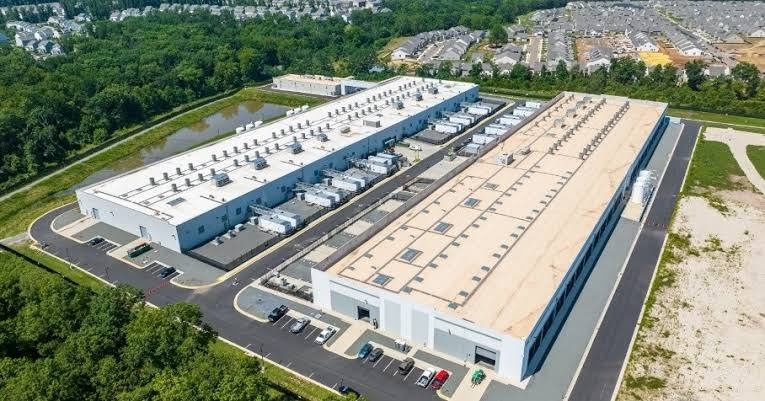
Typical Data Center
The first TerraPod will let the companies determine whether the design can be manufactured, transported, installed, powered, cooled, and maintained at the expected cost. It should also reveal whether Workhorse’s equipment and workforce can handle the product without a major, expensive factory reconfiguration.
A prototype is where assumptions finally meet reality. Sometimes they get along. Sometimes reality tells everyone to return to the drawing board.
Modular Data Centers Are Becoming a Real Market
TerraPod is part of a much larger shift taking place across offsite construction. Artificial-intelligence computing requires enormous amounts of power, cooling, and specialized infrastructure, while traditional data centers can take years to plan, permit, and construct.
Technology companies do not want expensive processors sitting in warehouses while conventional buildings slowly move through design and construction. That makes modularization especially attractive because factories can assemble and test electrical systems, cooling equipment, server racks, controls, and other infrastructure while the site is being prepared.
Completed units can then be shipped and connected wherever suitable power and computing demand are available. The concept is not completely new, but AI is changing its scale and urgency.
Companies including NVIDIA, Crusoe and others are turning modular data centers into repeatable manufactured products instead of treating every facility as a completely separate construction project. That creates an opening for existing manufacturers with the right combination of space, fabrication skills, electrical knowledge, and quality-control systems.
A factory does not necessarily have to build homes forever simply because it began by building homes. It also does not have to keep making delivery vehicles forever. The building, equipment, and trained workforce are all assets, and management’s job is to determine which products can use those assets profitably.
Stop Counting Letters of Intent as Backlog
The larger lesson is about how the offsite industry reports business opportunities. A memorandum of understanding is not a purchase order, and a letter of intent is not guaranteed revenue. A proposed pipeline is not factory backlog, and even a signed project may not be ready for production if financing, permits, engineering, or customer approvals remain unresolved.
Workhorse’s SEC filing is unusually clear about this distinction. The company states that there is no assurance a definitive supply agreement will be signed or that Rhaelm will place the contemplated 150-unit order.
That does not mean the opportunity is meaningless. It means the opportunity should be described honestly. Workhorse has a real $10 million assignment to build one full-scale TerraPod specification unit. If the product performs as expected and the parties reach a definitive agreement, the relationship could become much larger.
Nobody should schedule 150 units, hire workers for 150 units, or value the production pipeline as though those units have already been released. Factories get into trouble when they treat possibilities like production orders because payroll, equipment leases, and building expenses arrive every week. An optimistic press release cannot pay them.
The Prototype Has to Earn the Factory
The next important milestone is not another announcement. It is a completed TerraPod that can be tested against real manufacturing and operating requirements.
Can Workhorse build it at the target cost and repeat the process? How much customization will Rhaelm demand? Will the cooling and electrical systems perform after transportation? How much additional capital would Workhorse need to move from one unit to 150?
Those answers will determine whether TerraPod becomes a genuine production program or remains an expensive prototype. For now, the $10 million agreement deserves attention because it is funded, specific, and connected to an existing factory.
The possible 150-unit order deserves attention too, but it should remain in the “potential” column until someone signs a definitive contract and releases the units for production.
Gary’s Observation

I like this approach because Workhorse is not asking investors to finance a shiny new factory before proving there is a product worth manufacturing. It already has the building, equipment, and industrial workforce. Rhaelm is paying real money to find out whether TerraPod can move from a design concept to a repeatable manufactured system.
However, I have watched the offsite industry turn too many letters of intent into imaginary backlog. A company announces that someone may purchase 100, 500 or 1,500 units, and suddenly everyone begins talking as though those units are already moving down the line. Six months later, nobody wants to explain why the factory is still quiet.
Workhorse has one funded TerraPod assignment. If that prototype performs well, the larger order could become an important production program and a smart second life for the Union City plant. Until then, the honest headline is also the most interesting one: Workhorse is being paid $10 million to prove it can build the product.
In offsite construction, optimism is useful. Knowing the difference between optimism and backlog is essential.