





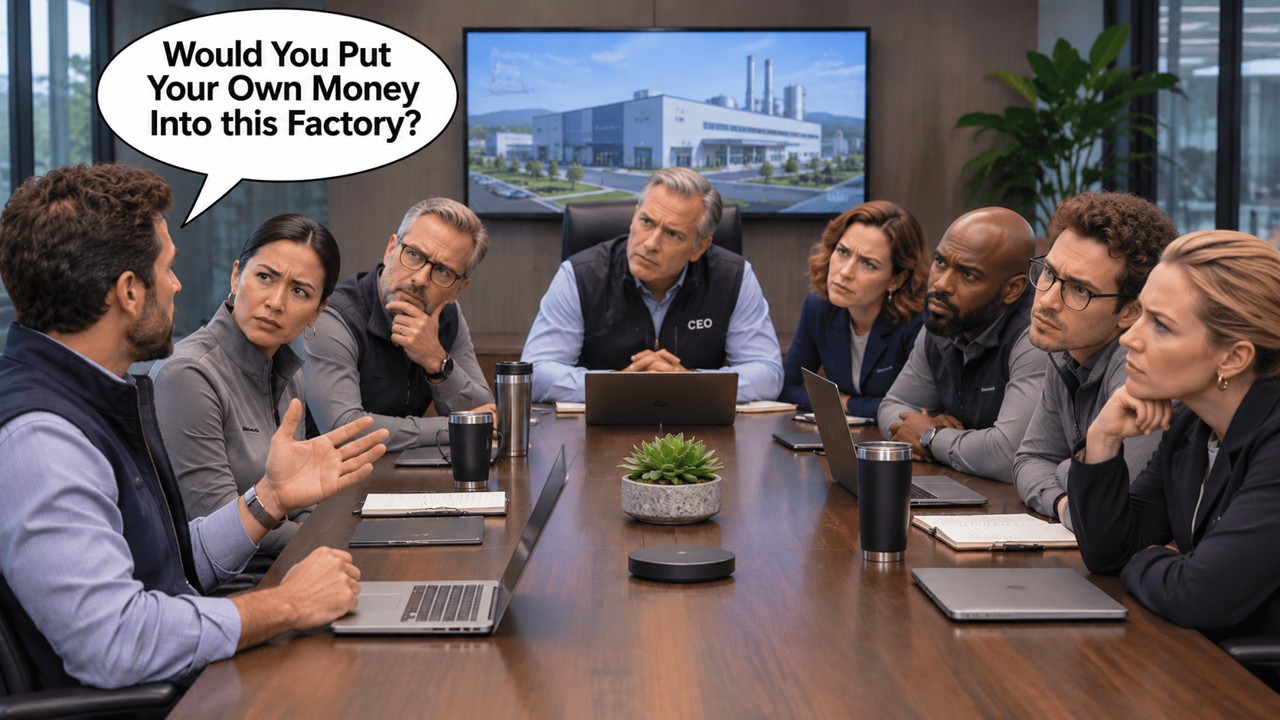
One question can make a confident management meeting uncomfortable.
Picture a factory’s monthly management meeting. Sales has a promising forecast. Production wants more people. Engineering wants new equipment. The general manager presents why the company should expand. Everyone has numbers, and most of them point in a reassuring direction.
Then somebody at the end of the table asks, “Would you put your own money into this factory?”
Nobody is being asked to empty a retirement account. It is simply a question. But suddenly, the people who were comfortable recommending how the company should spend its money begin thinking about what they know that never quite makes it into the presentation.
The builder who keeps threatening to leave. The production estimate that assumes every station will have a full crew. The service work still waiting from homes shipped months ago. The discount approved because the line needed something to build. That expansion forecast looks a little different when you imagine funding it from the account you share with your spouse.
For someone in upper management, this may be one of the most awkward positions imaginable: being asked to personally endorse the business they are paid to run.
The hesitation deserves a hearing
Before anybody turns this into a loyalty test, let’s get something straight. A manager can be exceptionally good at running a factory and have perfectly sound reasons for declining to invest in it. Having your paycheck and your savings depend on the same business is a serious concentration of risk. Family obligations matter. So do the investment terms and how much control you would actually have.
The useful part of this question is what comes after it: “What would you need to see before you felt comfortable?”
Now we are getting somewhere. If the answer is dependable financial reporting, realistic production schedules, stronger margins, or fewer promises made without checking with operations, ownership should pay attention. Those are conditions the factory probably needs, whether that manager ever invests a dime.
I would be much more interested in an honest, uncomfortable explanation than an enthusiastic yes delivered because the owner was watching.
That equipment purchase suddenly needs more homework
Spending company money on equipment can feel productive before the equipment produces anything. There is a demonstration, a proposal, a financing discussion, and a calculation showing how many labor hours the machine could save. Everybody can picture it sitting on the factory floor.
When your own savings enter the picture, you start asking less glamorous questions. Is this machine addressing the operation that actually limits output? Will the work arriving at it be consistent enough to use its capacity? Who will maintain it? What happens to production while people learn to operate it?
A faster wall line has limited value if completed walls simply wait longer for the next operation. A machine capable of handling tomorrow’s volume still has to justify its cost against the work you can reasonably expect to sell.
I like equipment that earns its place. But I would want someone to explain the installation, training, maintenance, financing, and likely downtime with the same enthusiasm they used to explain the purchase. If I were writing the check, “We need to modernize” would start the conversation.
Hiring becomes a question about the work
When production falls behind, the request for more people usually arrives right on schedule. Sometimes it is absolutely justified. A factory cannot expect a permanently understaffed crew to deliver dependable results through determination and overtime.
But suppose the additional payroll came directly out of your checking account. Would you approve six more positions before finding out why the people already on the payroll keep waiting for material, drawings, decisions, or equipment?
You might discover that the factory needs another electrician. You might also discover that it needs someone to stop releasing incomplete jobs. Those are very different problems, and adding people to the wrong one can make it more expensive without improving it.
The same scrutiny belongs upstairs. An experienced production leader, estimator, or purchasing manager may be worth considerably more than the salary difference that makes management hesitate. Saving money on a critical position can become an expensive habit when everyone else spends the year working around the consequences.
Personal ownership should sharpen judgment about people. It should also make management more willing to invest in the people who prevent losses.
Production promises become financial commitments
Promising a delivery date is remarkably easy when somebody else has to make it happen. Sales wants the order. The builder wants certainty. Management wants to keep the relationship moving. A date gets offered, and production inherits it.
If you were personally paying for the consequences, you might ask a few questions first. Are the plans approved? Have the selections been finalized? Are the materials available? Does the schedule allow room for the work, or does it only work if every other job behaves perfectly?
A delivery commitment can carry costs well beyond the factory gate. Builders arrange crews, transportation, equipment, and site work around it. Inside the plant, an unrealistic promise can trigger overtime, rushed purchasing, disrupted sequencing, and mistakes that need correcting later.
When the promise gets expensive, the explanation is often that production failed to meet the schedule. Sometimes the more honest explanation is that management sold a schedule production never had a reasonable chance of meeting.
I would want that distinction made before I invested.
The discount comes out of somebody’s pocket
An empty production slot can make almost any order look attractive. The buyer knows it. Sales knows it. Eventually, someone suggests taking a little off the price to keep the line moving.
There are legitimate reasons to accept work at a lower margin. But “keeping people busy” needs a calculation behind it. What will this particular order contribute after its additional costs? What customization does it require? What payment terms come with it? What happens if better work becomes available?
Imagine being told that the factory needs a $20,000 price reduction to secure an order, and that you personally will cover the reduction. You would probably ask more questions than you would while signing a discount approval form.
You might still approve it. The difference is that you would want to know what you were buying with that $20,000. A valuable continuing relationship? A sensible way to cover costs during a temporary gap? Or one more demanding customer who has learned that waiting long enough produces a cheaper house?
A full factory can still have an unhealthy business inside it. Busy people and moving modules don’t answer the question.
Expansion becomes harder to applaud automatically
Few things make a management team feel more successful than discussing a larger building or a second factory. Expansion has photographs, announcements, and room for everybody to imagine a bigger future.
Using your own money changes the tour. You begin looking closely at the factory you already have. Can it produce consistently without extraordinary intervention? Are its margins understood? Can another management team repeat its results? Is the backlog firm enough to support the commitment?
Most of all, you ask whether the company has a capacity problem or an operating problem. A larger building can accommodate more production. It can also accommodate more unfinished work, inventory, confusion, and overhead.
Before putting personal savings into a second location, I would want evidence that the first operation works without three exhausted people rescuing it every Friday. Their dedication deserves recognition, but it’s hard to duplicate in an expansion plan.
Ownership has to tolerate the answer
Here is where this discussion becomes uncomfortable for the person asking the question, too. Some upper managers are held accountable for results while being overruled on the decisions that shape those results.
An owner approves a special price. A favored customer gets moved ahead in the schedule. A necessary repair gets postponed. Someone promises a custom feature without allowing for the engineering. Then the management team is asked why costs went up.
If ownership wants managers to think like investors, it has to let them challenge decisions like investors. That includes questioning the owner.
Inviting an honest assessment and punishing the first person who provides one adds little value. The manager who says, “I would need us to fix these three things first,” may be offering the most useful contribution of the entire meeting.
Gary’s Observation

I think this question belongs in more factory management meetings, as long as nobody is expected to bring a checkbook. Ask each person what would make the business worth investing in, what would make them hesitate, and which decision they would change first.
Then listen carefully to the answers that are hardest to hear. The purchasing manager may know something about supplier confidence. The sales manager may know why builders are drifting away. The production manager may have spent two years explaining a problem everyone else has learned to tolerate.
Managers already have something invested in these businesses: their time, their reputation, and often a considerable amount of their family life. Their hesitation should make ownership curious.
“Would you put your own money into the factory you manage?” is a fair question. But once somebody answers, “Only if we changed a few things,” the next move belongs to the people with the authority to make those changes.