

I read the recent article in Governing Magazine about states passing “equal treatment” zoning laws for manufactured housing, and while I understand why supporters are celebrating these legislative victories, I also found myself thinking something the offsite construction industry desperately needs to hear.
Passing a state law doesn’t mean local communities will suddenly welcome factory-built housing with open arms. Not even close.
Over the past few years, states such as Maryland, Maine, Kentucky, Montana, and Virginia have passed laws intended to prevent local governments from discriminating against manufactured housing. The idea sounds simple enough. If a town allows a site-built single-family home, it should also allow a factory-built home. On paper, that sounds like a breakthrough.
But local zoning boards have been defending themselves against anything they don’t like for generations, and they’ve become experts at creating what I call poison pills. They may no longer be able to outright ban certain factory-built homes, but they can still create requirements that quietly kill projects before they ever leave the drawing board.
Local Governments Rarely Give Up Control Easily
Most zoning officials know exactly how to slow down or discourage projects they don’t fully support. Instead of issuing an outright rejection, they simply create layers of requirements that become financially or practically impossible to satisfy.
Minimum roof pitches, garage mandates, permanent masonry requirements, oversized lot restrictions, architectural review boards, landscaping rules, setback changes, and foundation specifications can all be used to make a project less attractive or financially unworkable. Even small requirements, when combined, can quietly destroy affordability.
Then come the delays.
Special hearings get scheduled months apart. Additional engineering reports are requested. Traffic studies appear out of nowhere. Neighborhood compatibility meetings suddenly become necessary. Before long, the developer, builder, or modular company is bleeding money while trying to navigate a process that was never designed to welcome them in the first place.
That’s why I believe our industry has to stop thinking legislation alone solves the acceptance problem. In many communities, it simply changes the battlefield.
The IRC and HUD Code Confusion Continues
One of the biggest obstacles we still face is the public’s inability to distinguish between IRC modular homes and HUD Code manufactured homes. To many local officials, planners, lenders, and residents, factory-built housing is still viewed as one giant category.
Unfortunately, that confusion continues to hurt the modular industry every day.
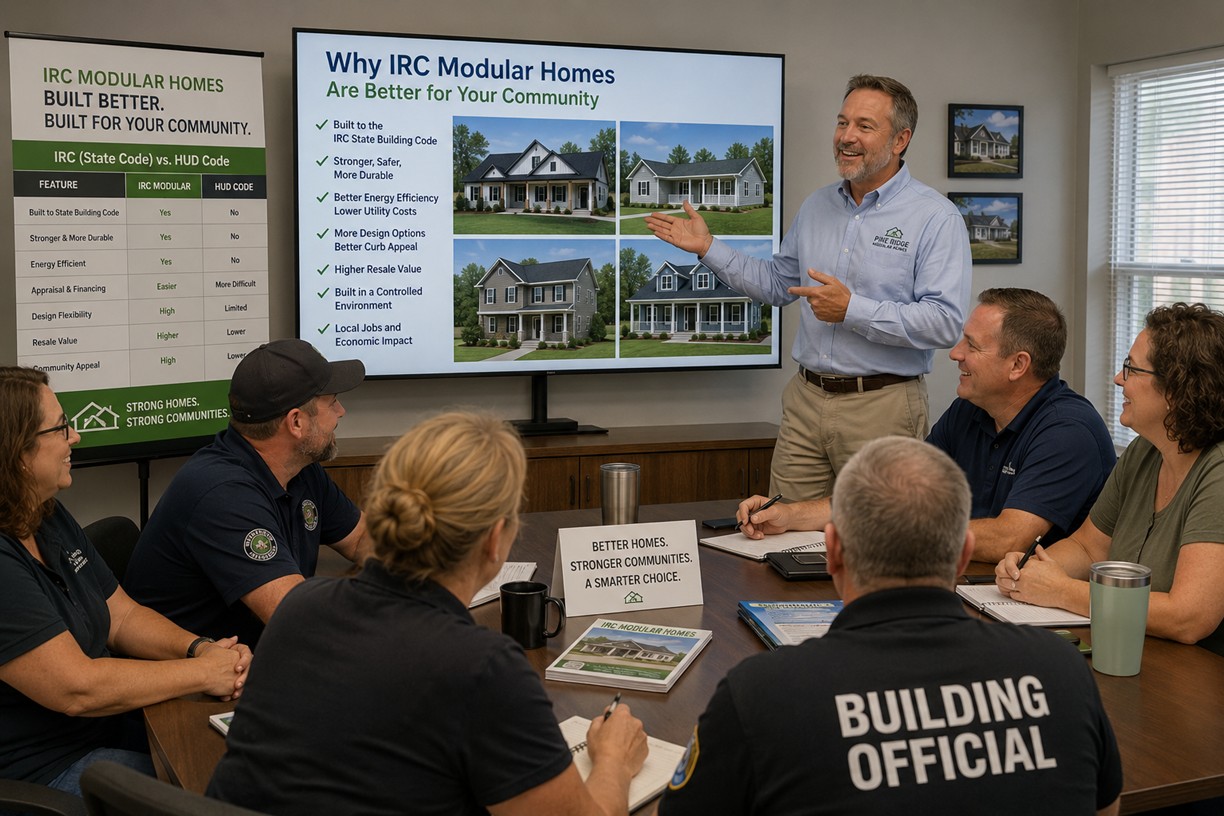
Modular homes built under the IRC are constructed to the same residential building codes as site-built homes. They are inspected, engineered, and approved in accordance with state and local building requirements. Manufactured homes, meanwhile, are built under the federal HUD Code, which follows an entirely different regulatory system.
Yet the moment someone at a zoning hearing says the word “mobile home,” the conversation often shifts emotionally rather than factually.
I’ve watched it happen more times than I can count. A resident stands up and says they’re worried about property values. Another mentions trailer parks from decades ago. Somebody else complains about temporary housing. Suddenly, an IRC modular home that meets all local code requirements is being treated as if it has no business in the neighborhood.
That misunderstanding doesn’t disappear just because a state legislature passes a law.
The Industry Must Stop Assuming People Understand Modular
One of the biggest mistakes our industry makes is assuming people already understand what modular construction is. Most don’t.
We spend enormous amounts of time talking to ourselves at conferences, conventions, webinars, LinkedIn discussions, and industry events. Meanwhile, the people actually making zoning decisions often have little or no firsthand knowledge of modern modular construction.
That disconnect is costing the industry opportunities.
Most local officials have never toured a modular factory. Many have never seen the engineering packages behind a modular home. Some still believe modules are lightly built boxes shipped down highways and stacked together with little oversight. Others assume modular construction sacrifices quality for speed.
The reality, of course, is often the exact opposite.
Modern modular homes are precision-built in climate-controlled environments with engineering standards, inspections, and quality controls that many site-built projects would struggle to match consistently. But unless local officials actually see that process, they will continue to rely on outdated assumptions.
Education Has to Become a Full-Time Industry Effort
I believe every modular factory, dealer, builder, and developer should actively educate local governments in their markets. Not selling to them. Educating them.
There’s a major difference between the two.
Invite zoning officials to tour factories. Bring planning board members through completed homes. Walk inspectors through engineering details and inspection systems. Show local leaders how modules are constructed, transported, and installed. Demonstrate energy efficiency, structural performance, and code compliance.
Most importantly, explain repeatedly that IRC modular homes are built to the same residential code requirements as site-built homes.
If we don’t control the narrative, someone else will fill the gap with fear, misinformation, and decades-old stereotypes.
Our Messaging Problems Are Hurting Us Too
The offsite industry also needs to take some responsibility for the confusion surrounding factory-built housing. We often use terms interchangeably that mean completely different things to regulators and consumers.
Prefab, modular, manufactured, mobile, offsite, system-built, volumetric, and panelized are constantly blended together in marketing materials, news stories, and industry discussions. The average consumer — and many local officials — have no idea how these categories differ.
Frankly, it’s no surprise they become confused.
The public isn’t interested in our internal terminology debates. They want clear answers to very basic questions. Is the home safe? Will it last? Will it protect property values? Will it look appropriate in the neighborhood?
Those are the concerns our industry has to address directly and consistently.
If we continue assuming people automatically understand our products, we’ll continue facing resistance at the local level no matter how many laws get passed at the state level.
Modcoach Observation

I believe the modular industry has spent far too much time assuming logic alone would eventually win the zoning battle. But local politics is rarely driven by logic alone. It’s driven by perception, emotion, fear, and pressure from existing residents.
Even if every state in America passed equal-treatment zoning laws tomorrow morning, local governments would still have dozens of ways to slow projects down or quietly discourage them through poison-pill requirements buried inside approval processes.
That means our industry’s mission can no longer stop at building better homes. We also have to build trust, educate communities, and help local governments understand the enormous difference between IRC modular construction and HUD Code manufactured housing.
Until we do that consistently, many of those newly opened legislative doors will continue feeling only halfway open.