



I’ve been looking at Sweden again lately.
Not because I think the United States can magically become Sweden overnight, but because there are lessons hiding in plain sight that the offsite industry here keeps talking around instead of directly addressing.
In Sweden, roughly half of all new housing uses some form of industrialized offsite construction. Detached homes. Apartments. Workforce housing. Student housing. Entire neighborhoods. It has become part of the normal housing ecosystem instead of a niche alternative trying to prove itself every few years.
Meanwhile, in the United States, we still celebrate whenever modular construction gains another fraction of a percentage point in market share.
That should bother us.
Not because American factories are incapable of producing quality homes. Most of them absolutely can. The problem is that Sweden didn’t simply build modular homes. They built an entire ecosystem around industrialized housing, and that’s the part we still haven’t figured out.
Sweden Didn’t “Adopt Modular.” They Industrialized Housing
In the U.S., modular construction is still often treated like an alternative product. In Sweden, it’s treated as normal construction. That difference in mindset changes everything from financing to public acceptance to long-term planning.
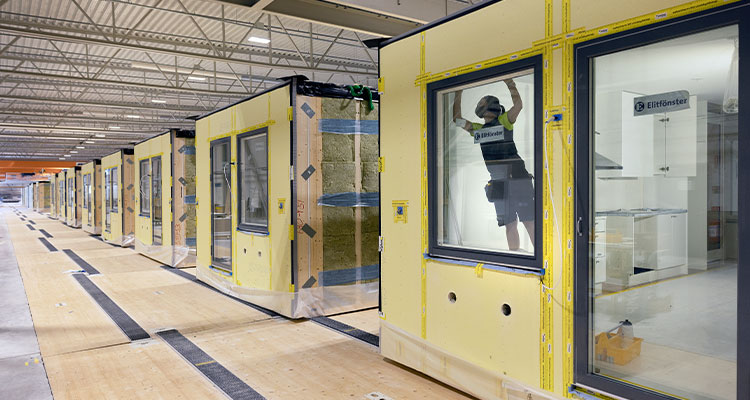
Photo – Lindbäcks – Sweden
The Swedish system was built around repeatability, logistics, energy efficiency, financing confidence, and predictable production schedules. Their factories don’t constantly swing between feast and famine because one developer disappeared or a builder suddenly changed suppliers.
Factories there operate more like manufacturing companies than construction companies.
That distinction matters more than most people realize.
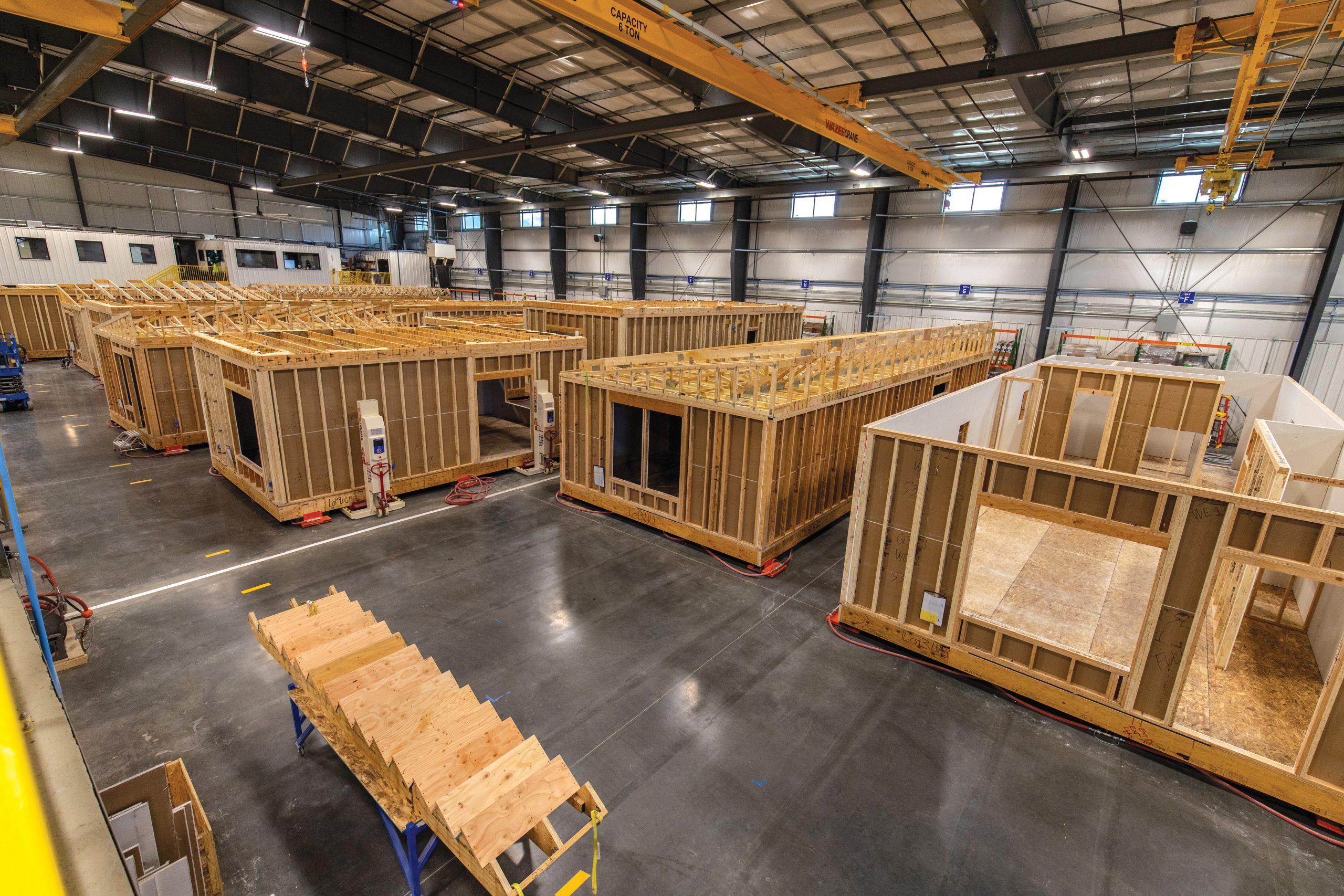
In America, too many modular factories still behave as though every project is a custom one-off experiment. That creates production inefficiencies, inconsistent quality, scheduling problems, and pricing uncertainty that scares away developers and lenders.
Sweden standardized enough of the process to allow factories to improve over decades instead of constantly reinventing themselves.
America Keeps Trying to Sell “Different”
One of the biggest mistakes the U.S. modular industry makes is trying too hard to prove modular is unique or revolutionary.
Consumers don’t wake up wanting modular construction.

They wake up wanting a beautiful home delivered on time, at a fair price, with predictable quality and fewer headaches. The modular industry often markets the process instead of the outcome, and that disconnect continues to limit acceptance.
Sweden learned long ago that buyers care more about reliability than innovation buzzwords.
That’s why many Swedish modular companies quietly focused on consistency instead of trying to convince the public they were changing the world. Meanwhile, in the U.S., we sometimes sound more like technology startups than housing providers.
The U.S. Industry Spends Too Much Time Fighting Itself
This may be one of the hardest truths for the offsite industry to accept.
The American offsite industry still spends far too much time arguing internally about which system is superior. Volumetric modular versus panelization. Steel versus wood. Robotics versus labor. HUD versus IRC. Custom versus production.
Sweden largely moved beyond those arguments years ago because the mission became bigger than the individual systems being used.
Build housing efficiently.
Build it sustainably.
Build it repeatedly.
Build it profitably.
In the United States, parts of the industry still behave like competing camps instead of pieces of the same industrialized housing movement. That fragmentation slows acceptance and confuses developers, municipalities, and lenders that are already unsure about offsite construction.
Financing and Appraisals Continue to Hold America Back
Factories can improve production all they want, but if lenders, appraisers, insurers, and developers remain uncertain, growth will stay limited.
Sweden normalized industrialized housing through decades of predictable performance. Banks understand it there. Municipalities understand it. Consumers understand it. Developers know what to expect.
In America, a modular project can still trigger confusion at nearly every level of the process.
I’ve watched “new-to-modular” developers spend months learning basic realities about transportation costs, crane expenses, set crews, utility hookups, code approvals, scheduling coordination, and financing structures. That learning curve alone scares many people away before a project even begins.
The industry desperately needs more education aimed at developers, lenders, municipalities, and real estate professionals, instead of factories mostly talking to other factories.
The Missing Ingredient Is Patience
Sweden’s success didn’t happen in five years or even ten.
It evolved over generations through steady improvements, consistent performance, and public confidence. That’s something America struggles with because investors often want explosive growth charts while factory owners want immediate production volume.
Industrialized construction doesn’t grow like software companies.
It grows through trust built slowly over time. One successful project leads to another. One municipality becomes comfortable. One lender gains confidence. One developer returns for a second project.
The companies that survive long enough to build that trust usually become the companies that define the industry.
So What Can the U.S. Industry Actually Do?
We probably won’t jump from 25,000 modular homes a year to 250,000 anytime soon, but there are realistic ways to begin moving the needle.
Welcome To the Future of Home Construction
Factories could work together on developer education instead of competing for the same small pool of informed buyers. Industry associations could focus less on self-promotion and more on teaching municipalities and lenders how industrialized construction actually works in the real world.
Factories could simplify product lines instead of chasing endless customization that destroys manufacturing efficiency. Developers need clearer financial models showing predictable schedules, reduced carrying costs, and lower risk exposure.
Most importantly, the industry needs fewer promises about “disrupting housing” and more examples of projects quietly succeeding year after year.
That’s how trust gets built.
That’s how Sweden did it.
Modcoach Observation

I don’t think America needs to become Sweden.
But I do think we need to stop pretending modular construction is still some strange experiment sitting off to the side of the housing industry. The real question isn’t whether offsite construction works anymore because we already know it does.
The real question is whether the people in the industry are finally willing to work together long enough and consistently enough to make the rest of the country believe it, too.