





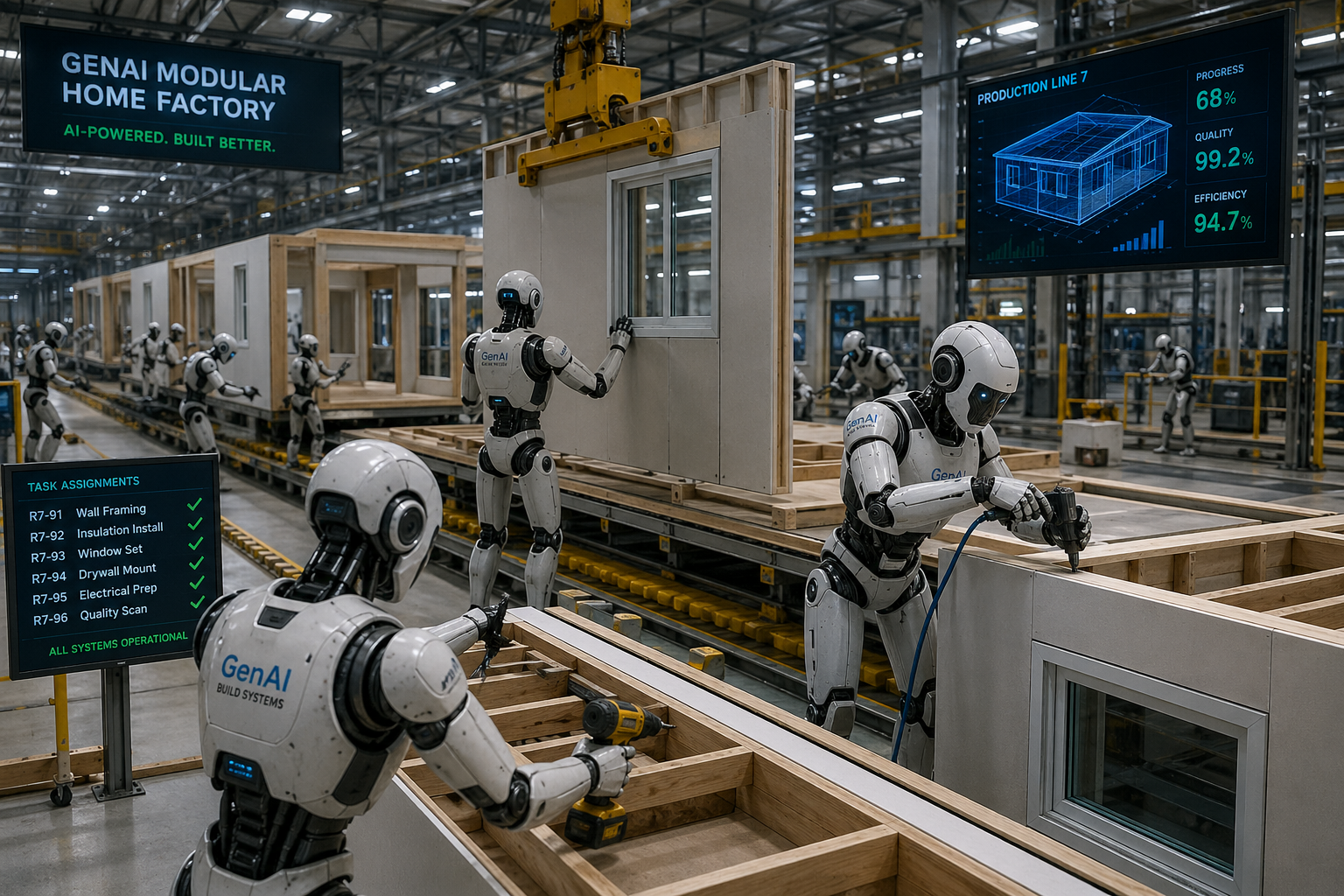
There’s a conversation beginning to surface in offsite construction boardrooms that hasn’t quite made it to the production floor yet. It’s not about another saw, another line upgrade, or even another ERP system. It’s about something that looks a lot more like the guy standing next to your crew—except it doesn’t need a paycheck.
And management isn’t asking if they should look at it. They’re asking when.
The Labor Problem That Won’t Sit Still
Factory owners have been chasing the same issue for over a decade now, and it hasn’t improved nearly as much as anyone hoped. Skilled labor is still hard to find, harder to keep, and increasingly expensive to train.
Even when a plant is fully staffed, it rarely feels fully stable. Turnover, absenteeism, and uneven skill levels create a constant drag on production that never quite shows up cleanly on a spreadsheet but always shows up in missed schedules and callbacks.
From management’s perspective, a humanoid robot isn’t a futuristic toy. It’s a potential answer to a problem that refuses to go away.
Why Not Just Use More Traditional Automation?
That’s the logical pushback, and many factories already have.
Panel lines, CNC machines, automated saws, and material handling systems have all helped improve efficiency. But they come with a limitation that every GM understands the moment production changes.
They’re fixed.
A robotic arm does one job exceptionally well. Move the workflow, change the product mix, or introduce customization, and suddenly that “perfect” machine becomes a constraint instead of an asset.
A humanoid robot, at least in theory, changes that equation. It can move through the factory, interact with tools designed for humans, and shift from one task to another without requiring a complete reconfiguration of the production line.
That flexibility is what’s catching management’s attention.
Are They Ready for the Big Game?
Not quite—but they’re no longer sitting on the bench.
Today’s humanoid robots are already being tested in controlled environments, often handling repetitive or low-risk tasks. Think material movement, simple assembly steps, or support roles where speed isn’t as critical as consistency.
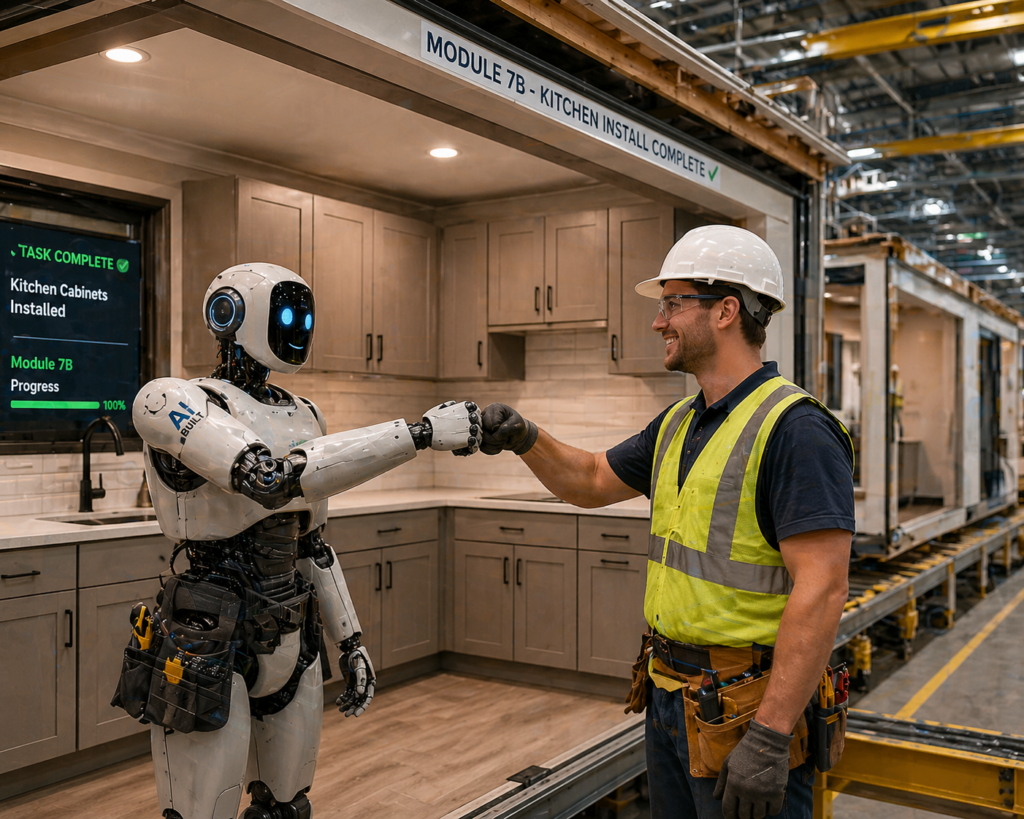
They’re not framing walls or setting modules yet. But they’re learning.
And that’s the part that should make factory owners pause. These machines aren’t static pieces of equipment. They improve over time, especially when paired with AI systems that allow them to adapt to new tasks.

In other words, they’re not ready for prime time—but they’re practicing on the field.
The Real Trigger: When Does Management Say Yes?
Factory management doesn’t make emotional decisions about capital investments, no matter how futuristic they sound. The trigger will come down to the same factors that drive every major decision in a plant.
Reliability will need to match or exceed that of a dependable worker. Not perfection, but predictability.
Cost will need to make sense not just in upfront investment, but in total lifecycle expense compared to hiring, training, and retaining human labor.
And perhaps most importantly, integration will need to be seamless. If adding a humanoid robot disrupts production more than it helps, it won’t matter how advanced it is.
The moment those three line up—reliability, cost, and integration—you won’t see one robot on the floor. You’ll see five.
The Camera That Never Blinks
Here’s where the conversation gets a little uncomfortable, even for seasoned executives.
If you’re going to spend a significant amount of money on a humanoid robot, why wouldn’t you take full advantage of what it can see?
Unlike a human worker, a robot can be equipped with cameras that provide continuous, multi-angle visibility of everything happening around it. Not just for navigation, but for documentation, quality control, safety monitoring, and performance analysis.
From a management standpoint, this is a goldmine. Every movement, every process, every inefficiency can be captured and reviewed. Problems that used to take weeks to diagnose could be identified in hours.
And then comes the inevitable question.
Why turn it off at the end of the shift?
A robot doesn’t get tired. It doesn’t mind working overnight. It doesn’t object to monitoring an empty factory for safety or security issues. In fact, keeping it active could provide a level of oversight most plants have never had.
But that same capability raises a different kind of issue. At what point does operational visibility cross into something that feels more like constant surveillance?
That’s not just a technical decision. That’s a cultural one, and it may end up being harder to manage than the robot itself.
Smarter Than It Should Be?
The next layer of this discussion moves from hardware to intelligence.
Do you program the robot to perform a fixed set of tasks, or do you give it the ability to learn and adapt using generative AI?
On paper, the adaptive model is far more powerful. A robot that can observe a process, learn it, and improve its performance over time sounds like the ultimate factory employee.
But factories don’t run on “almost right.” They run on repeatability.
Introducing a system that can change how it performs a task, even slightly, introduces a level of unpredictability that most production managers are not comfortable with. Consistency builds profit. Variation erodes it.
So while the idea of a thinking robot is appealing, most early adopters will likely keep a tight leash on what that “thinking” actually allows.
A Decision That Isn’t Just About Production
From the outside, this looks like a technology decision. From the inside, it’s much bigger than that.
Factory owners aren’t just evaluating whether a humanoid robot can do the work. They’re evaluating how it changes the entire dynamic of the plant.
How will crews react?
Will productivity actually improve, or will it stall during the transition?
Does the long-term upside outweigh the short-term disruption?
These are not small questions, and they won’t be answered overnight.
The Modcoach Observation

Factory management has always chased efficiency, but it has usually come in the form of faster machines, better processes, or tighter systems.
Humanoid robots are different.
They don’t just promise to change how the work gets done. They threaten to change who—or what—is doing it.
And the moment a factory owner realizes that a machine might finally solve a labor problem that hasn’t budged in 20 years, the question won’t be whether to bring one in.
It’ll be whether they can afford to wait while the factory down the road already has.